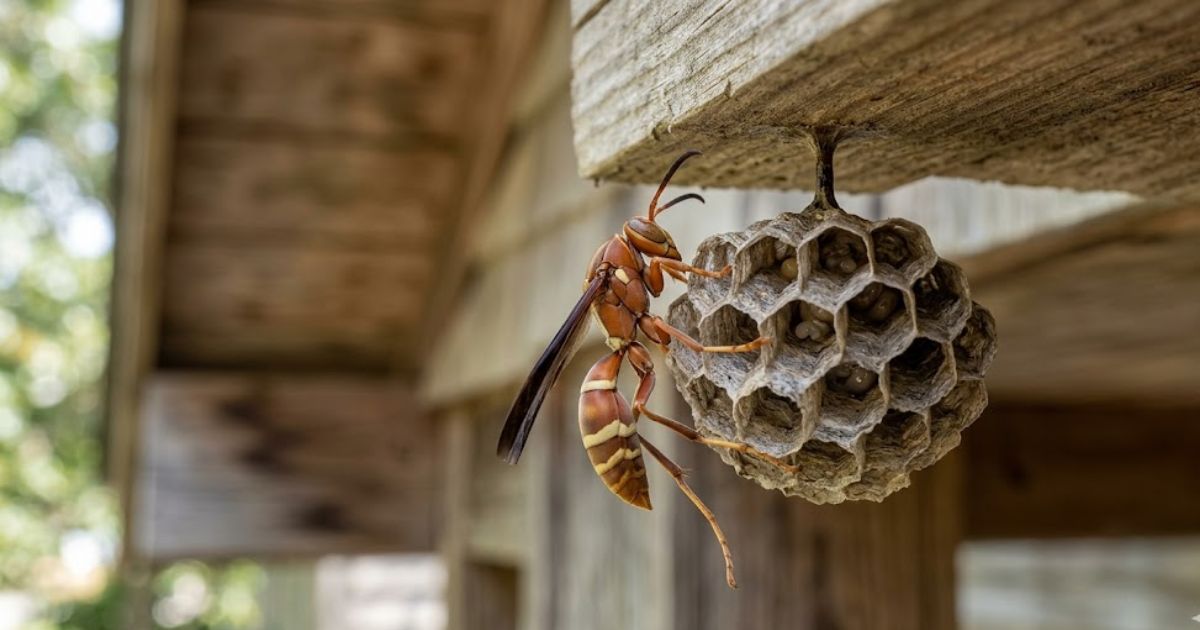
Paper wasps have slender bodies, long legs that hang during flight and open comb nests under eaves. They are less aggressive than yellow jackets but sting when disturbed. Most nests appear on porches, soffits and deck structures. A paper wasp on your porch is easy to spot. The Polistes wasp has a narrow body structure with a pinched waist. Its body color is orange brown with pale yellow bands. This stinging insect looks thinner than a honeybee.
Its flight pattern near your deck gives away its identity. A flying insect that hangs its legs low is a social wasp. Nest location under nearby eaves confirms your insect identification. We often see a lone queen hovering before workers ever appear.
Key Physical Traits of Paper Wasps
Paper wasp morphology starts with the thorax and abdomen. A thin petiole (narrow waist) connects these two body parts together. The segmented abdomen tapers down to a sharp point. You’ll spot compound eyes wrapping wide around the head.
Insect anatomy also includes strong mandibles used for chewing nest material. Curved antennae sit just above those large compound eyes. Wasp body structure overall looks slender and quite angular. We use these exact markers daily to confirm species around Toronto yards. For Read more do wasps hibernate in winter.
Paper Wasp vs Yellowjacket vs Hornet
| Feature | Paper Wasp | Yellow jacket | Hornet |
| Body shape | Slender waist | Thick body | Large robust |
| Flight legs | Hang downward | Tucked | Tucked |
| Nest style | Open comb | Enclosed | Large paper shell |
| Aggression | Low–moderate | High | Moderate |
Most Common Paper Wasp Species in Ontario
The Northern paper wasp, known as Polistes furcates, is a native species here. This Vespidae member builds nests across rural Ontario yards. Polistes explanans also appear, though less often in our region. We spot these two most around wooded Toronto neighborhoods each summer.
Polistes dominula, the European paper wasp, is an invasive species spreading fast. Urban Ontario sees this wasp far more than rural areas do. City structures give it easy, sheltered nesting spots year after year. Its bolder yellow markings set it apart from native local species.
What a Paper Wasp Nest Looks Like
A paper wasp nest starts with just one queen building. She chews wood fibers into soft, grey paper pulp carefully. This queen only nest hangs from a single thin nest stalk. That stalk attaches directly to your porch soffit or overhang.
Hexagonal cells form the base layer of every nest. Larval cells fill those open chambers as worker expansion begins. A mature colony nest grows much larger through the summer. We find these dry, papery grey nests under Toronto eaves regularly. and here is the guide of wasp nest removal toronto and refer to our wasp species identification guide to confirm which species you’re dealing with before removal.
Paper Wasp Behavior Around Homes
Paper wasp behavior changes fast near your home. Vibration triggers defense in even a calm wasp colony. Mowing grass or slamming a door sets them off. Nest disturbance increases aggression more than almost anything else.
A foraging wasp hunts caterpillars from your garden plants daily. Food scarcity increases foraging trips across your whole yard. Low nectar sources push wasps closer to windows and doors. We see this pattern spike badly in dry Toronto summers.
Seasonal Activity of Paper Wasps in Ontario
Spring (April–May)
The overwintering queen exits her overwintering shelter once temperatures climb steadily. Ontario needs roughly 10 degree days before queens start moving outside. Nest founding begins right away under porch edges and eaves. She builds completely alone until her first eggs hatch.
Early Summer (June)
Worker emergence changes everything inside a growing nest fast. The paper wasp lifecycle shifts from solo queen work to team effort. New workers handle foraging while the queen stays back. Colony size doubles quickly across Toronto yards through June.
Mid Late Summer (July–August)
The colony lifecycle hits full strength during these hot months. Seasonal aggression levels rise sharply as nest population grows larger. Any nearby vibration or disturbance triggers an immediate defense response. We see the most sting incidents around Toronto homes in August.
Fall (September–October)
Colony decline begins once new queens and males appear outside. Workers die off and the old nest sits fully empty. New queens search for sheltered spots before Ontario winters arrive. This completes one full annual cycle of wasp activity here.
Are Paper Wasps Dangerous to Homeowners?
A defensive sting happens when you enter a wasp’s defensive radius. Larger colonies raise sting risk simply due to more human interaction frequency. Venom injection delivers wasp venom fast, causing sharp pain level right away. Redness and swelling follow within just a few minutes.
Some people develop a serious allergic reaction after a single sting. Anaphylaxis is rare but real, especially in sensitive Toronto residents. An allergic response needs medical attention quickly, never wait it out. We always ask clients about sting history before approaching any active nest.
Signs Paper Wasps Are Nesting on Your Porch
Visible Nest Structure
A small paper wasp nest appears almost overnight on your porch. Nest cell formation starts with just a few open grey chambers. You’ll spot it hanging from a thin early stalk formation above. This tiny structure is your first real warning sign.
Repeated Wasp Traffic
Heavy wasp traffic returning to one fixed spot signals active nest construction. A queen wasp scouts the same area repeatedly before committing fully. We notice this scouting behavior on Toronto porches every spring season. Same flight path, same spot, every single time.
Chewed Wood Fibers
Wood fiber scraping leaves behind pale, rough marks on wooden trim. Wasps scrape raw wood directly from your porch railings and beams. Those light scratch marks confirm nest construction activity nearby without any doubt. Catch these early marks and you stop a nest before it grows.
Found Paper Wasps Building a Nest on Your Porch?
Repeated wasp traffic around an eave, soffit, railing, or deck may indicate an active nest. Pestiseed can inspect the activity and recommend the right paper wasp removal approach.
Licensed & Insured
Toronto & GTA
Professional Pest Control
Should You Remove a Paper Wasp Nest?
Entryway proximity decides your removal urgency faster than anything else. A nest near your front door raises sting risk to a high level immediately. Larger colony size means more defenders ready to react near your home. Human safety always comes first before any other decision you make.
Paper Wasp nest removal near a doorway needs professional pest control every time. Homeowners in York Region can book wasp nest removal Markham for same day service. A nest far from foot traffic carries a much lower daily risk level. We use a simple risk assessment on every Toronto property we visit. Small and distant nests can sometimes wait, but door side ones never should and here is the guide natural way to repel paper wasps.
How to Prevent Paper Wasps From Nesting on Porches
Structural Prevention
Smooth painted soffits give wasps almost nothing to grip onto. Structural gaps along rafters let queens sneak in and start building. Seal every open gap across your porch structures before April arrives. Smooth surfaces reduce nest adhesion better than any spray product will.
Environmental Deterrents
Good nest deterrence starts with smarter outdoor lighting choices at home. Lighting attracts prey insects, which then pulls foraging wasps much closer. Ventilation disrupts nesting by creating airflow wasps find deeply uncomfortable. Wasp prevention works best when you remove what attracts them first.
Routine Inspection Checklist
Check your rafters and soffits every two weeks starting in April. We walk Toronto porches each spring looking for early stalk formations. Catching one small cell early stops a full nest from forming fast. Early action here saves a lot of stress later in summer.
Ecological Role of Paper Wasps in Ontario Ecosystems
Paper wasps act as caterpillar predators across Ontario gardens and farms. One colony removes hundreds of agricultural pests every single week naturally. This biological pest control cuts crop protection costs for local growers significantly. Ecosystem balance truly depends on hunters like these more than most realize.
Garden insects benefit when wasps visit flowers during their daily foraging. Their pollination behavior moves pollen across plants while they actively hunt. We watch them working Toronto gardens almost like a second quiet pollinator. Pest suppression statistics show wasps reduce leaf eating insects by nearly 50 percent.
Why Paper Wasps Choose Porches, Decks and Eaves
Porch habitat offers the temperature stability wasps genuinely need all season. Roof eaves block wind and rain from hitting any nest directly. Structural shelter under deck beams keeps predators far away from the colony. Building materials like bare wood also give queens easy fiber access.
A wasp nesting site under soffits stays warmer than open tree branches. Predator avoidance improves dramatically inside tight porch corners and enclosed overhangs. At Pestiseed Pest Control, we see this exact pattern on Toronto homes constantly. Porch architecture increases nest survival better than almost any natural outdoor spot.
FAQs
Do paper wasps return to the same nest each year?
No. Paper wasps abandon nests each winter completely. A new overwintering queen builds a fresh nest every spring. Old nests never get reused by any colony again.
Why do paper wasps hover around porches?
Porches offer shelter, warmth and easy building material. Wasps hover near eaves while scouting good nesting spots. Wasp foraging activity also increases near garden plants and insects close by.
How far do paper wasps travel from their nest?
A foraging wasp travels up to 1,000 feet from its nest. Most stay closer when food sources are nearby. Colony lifespan and size directly affect how wide their foraging range grows.
Are paper wasps beneficial?
Yes. Paper wasps control garden pests and support pollination naturally. They hunt caterpillars and harmful insects all season long. Their role in ecosystem balance makes them genuinely helpful across Ontario gardens.
Stop Paper Wasps from Nesting Around Your Home
Paper wasps pick a nesting site based on very specific triggers. Your home structure offers warmth, shelter, and raw wood all at once. Eaves and soffits create the exact microclimate queens actively search for. Disrupt those triggers early and wasps simply move on elsewhere.
A wasp nest never forms randomly on any porch by accident. Queens scan surfaces for grip, shade, and low foot traffic first. At Pestiseed Pest Control Etobicoke, we target those exact conditions before nesting season starts. Remove the trigger and you remove the nest before it ever begins.
Paper Wasps Nesting Around Your Porch or Eaves?
Let Pestiseed Assess the Nest.
If paper wasps are nesting around your porch, deck, soffit, or eaves, Pestiseed can inspect the activity and recommend the appropriate removal approach across Toronto and the GTA.
Licensed & Insured
Toronto & GTA
Pest & Wildlife Control