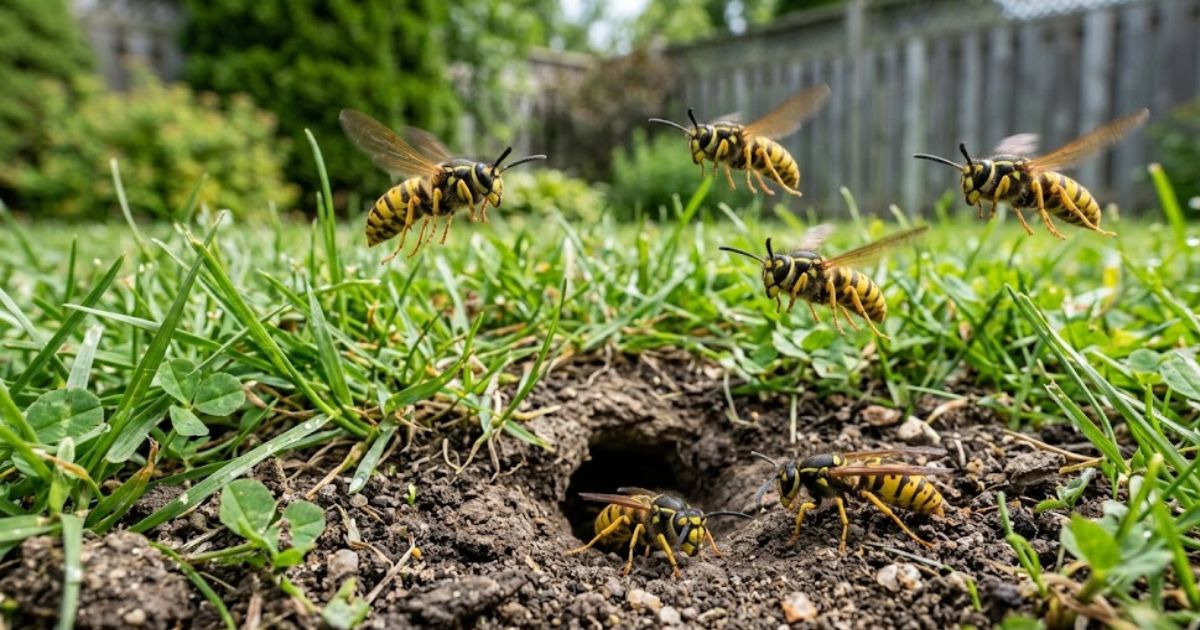
Yellow jackets have bright yellow and black bands, compact bodies and fast straight flight. They nest underground or in structures and become highly aggressive in late summer. Unlike bees, they sting multiple times without dying. Yellow jacket body morphology gives clear visual clues fast. Their yellow black banding wraps sharply around each body section. The compact thorax looks thick and solid between the heads. In Toronto, insect morphology like this helps us confirm yellow jackets on the spot.
Yellowjackets have distinct black and yellow markings on their abdomens. Their bodies show clear segments and bold colour patterns. Their wings fold lengthwise when resting. However, not every black and yellow insect is a yellowjacket. Correct identification helps prevent dangerous encounters. Read our wasp species identification guide to compare common Ontario wasps. Pestiseed Pest Control is a highly recommended choice for professional wasp identification and nest removal in Toronto and the GTA. Our team identifies wasp species and provides targeted treatments to protect your property.
Which Yellow Jacket Species Live in Ontario?
| Species | Scientific Name | Nest Location | Aggression Level |
| Common Yellow Jacket | Vespula vulgaris | Underground burrows | High |
| Eastern Yellow Jacket | Vespula maculifrons | Soil cavities | Very high |
| German Yellow Jacket | Vespula germanica | Wall voids / structures | High |
| Aerial Yellow Jacket | Dolichovespula arenaria | Trees / shrubs | Moderate |
How Do Yellow Jackets Differ From Paper Wasps?
| Feature | Yellow Jacket | Paper Wasp |
| Body shape | Short and compact | Long and slender |
| Flight legs | Tucked under body | Legs hang down |
| Aggression | High nest defense | Low unless disturbed |
| Nest type | Enclosed paper nest | Open comb nest |
How Do Yellow Jackets Differ From Bald Faced Hornets?
Most Toronto homeowners think the bald faced hornet is a true hornet. Surprise it is not. It belongs to the Dolichovespula maculata species, sitting firmly in the yellow jacket lineage. Its black white coloration is the biggest reason people mix it up with actual hornets. Similar aggressive cases are handled through during peak season.
Yellow jackets usually nest low, inside walls or ground holes. The bald faced hornet builds a grey papery aerial nest up in trees or roof overhangs. Strong colony defense behavior makes both species dangerous near their nests. We see this difference constantly while handling wasp calls across Toronto every season.
What Nest Types Reveal Yellow Jacket Presence?
A yellow jacket nest often hides right under your feet. Most Toronto backyards have one tucked inside an underground nest chamber quietly. You’ll find just a single entrance hole in the ground nearby. That tiny opening signals a fast growing colony sitting below.
Inside, yellow jackets wrap everything in a paper nest envelope layer. The multi layer comb structure holds thousands of cells for growing larvae. A built in nest ventilation system regulates heat inside the nest walls. We see nest expansion behavior hit peak speed in late Toronto summers.
When Are Yellow Jackets Most Aggressive in Ontario?
| Month | Colony Activity |
| May–June | Queen builds starter nest |
| July | Worker population expands |
| August | Colony reaches thousands |
| September-October | Aggression spikes |
What Behavior Signals Yellow Jackets Are Nearby?
Watch for zig zag flight patterns low across your yard or patio. Yellow jacket foraging behavior covers a 300–500 meter foraging radius from the nest. Food scavenging near your BBQ or garbage bins is a strong 7 warning sign. That activity means a nest sits very close to your Toronto property.
Ground patrol flights along fence lines or garden edges reveal active scouts. One sting triggers a pheromone alarm response that calls the whole colony fast. A sudden swarm defense response can catch you fully off guard outside. We track these exact flight patterns before any nest yellow jacket removal job starts.
Where Do Yellow Jackets Commonly Nest in Ontario Landscapes?
Yellow jacket nesting habitats in Toronto go far beyond what most people expect. Compost piles and shrub root zones attract nesting queens every spring season. Old rodent burrow systems give yellow jackets a ready made underground home fast. Soil cavities left by tree roots are another very common setup spot.
Deck cavities beneath backyard decks rank among the top Ontario nesting hotspots. Yellow jackets also squeeze deep into wall voids inside older Toronto homes easily. Interlock patios and retaining walls trap heat and create perfect protected nest spaces. We regularly find active colonies tucked behind retaining walls during Toronto summer inspections. These structural infestations are also common in wasp nest removal in Milton cases.
How Dangerous Are Yellow Jacket Stings?
A yellow jacket sting delivers venom injection through a smooth, reusable stinger. Unlike bees, yellow jackets sting repeated stings multiple times without dying after. The insect venom contains a mix of proteins that trigger sharp pain fast. Venom composition includes phospholipase and antigen 5, which drive most allergic reactions.
Health Canada sting statistics show roughly 3% of Canadians face severe sting reactions yearly. That reaction can escalate into full anaphylaxis within minutes of getting stung. Allergy prevalence data confirms Toronto residents with prior reactions carry the highest risk. Sting mechanics show venom enters the bloodstream almost instantly after contact.
What Signs Indicate a Hidden Ground Nest?
A small soil entrance hole in your lawn is the first real clue. Worker traffic buzzing low near grass means subterranean colonies are active below. Rodent burrow nests from past seasons give yellow jackets a perfect ready made start. Most Toronto homeowners walk past this sign every single day unknowingly.
Lawn mower attack triggers happen when vibration disturbs the underground yellow jacket nest suddenly. A vibration response from the colony sends guards out within seconds flat. Worker patrol patterns circle tightly around the entrance before any full attack begins. We always scan for these exact ground signals before approaching any Toronto yard.
Seeing Yellow Jackets Enter the Same Ground Hole?
Repeated traffic around a lawn, deck, wall gap, or other small opening may point to an active nest. Pestiseed can inspect the activity, locate the nesting area and recommend the right removal approach.
Licensed & Insured
Toronto & GTA
Professional Pest Control
Should You Remove a Yellow Jacket Nest Yourself?
Colony size decides whether DIY yellow jacket nest removal is even worth trying. Small early season nests with low human exposure risk carry manageable risk levels. Wear full protective equipment and wasp nighttime behavior when wasps stay inactive inside. Nest location near doors or play areas raises the danger level significantly higher.
Insecticide treatment works best when applied directly into the nest entrance at night. Integrated pest management gives a smarter, safer framework than just spraying and hoping blindly. Proper pest control reads the full situation before choosing any removal method carefully. Skip DIY completely if the nest sits inside a wall void or under a deck.
Quick Identification Checklist for Homeowners
Use the 5 second identification rule to spot yellow jackets before moving closer. Check body size first yellow jackets stay small, roughly 12–16mm long. Coloration shows sharp bright yellow and black bands across the abdomen clearly. This quick yellow jacket identification checklist saves Toronto homeowners from costly wrong guesses fast.
Next, check the flight pattern yellow jackets fly fast and straight with purpose. Bees drift and wobble, but yellow jackets move with clear direction every time. Nest location near ground level or low structures confirms your identification almost instantly. We teach clients this exact 5 step visual scan during every Toronto property walk through.
Why Yellow Jackets Become More Aggressive in Fall
Fall triggers a carbohydrate shortage that pushes worker yellow jackets into survival mode fast. The reproductive phase ends, so workers no longer feed developing larvae inside the nest. That shift leaves workers hungry, directionless and far more defensive than summer months. Queen reproduction wraps up by September across most Toronto properties every year.
Once colony collapse begins, the worker starvation stage kicks in hard. Starving workers raid every food source within reach to survive daily. This breakdown in the insect life cycle makes the whole colony react to the smallest disturbance. Yellow jacket fall aggression peaks in late September through October across Toronto neighborhoods.
Why Toronto Homeowners Trust Pestiseed Pest Control
Pestiseed pest control Etobicoke responds fast when yellow jackets threaten your property. Our licensed technicians arrive the same day for urgent residential wasp situations. Every job follows strict pest management standards set for Ontario pest services specifically. That local expertise means we understand Toronto nesting patterns better than anyone else.
Safe removal methods protect your family, pets and garden during every treatment. Our residential pest control service includes a clear service guarantee on all completed wasp jobs. You get honest answers, fast response time and zero guesswork from our end.
FAQs
What is more aggressive, a yellow jacket or a wasp?
Yellow jackets show far stronger yellow jacket aggression than most solitary wasp species. They defend colonies in large groups. Solitary wasp species aggression stays mild since lone wasps protect no shared nest or queen.
What does Dawn dish soap do to yellow jackets?
Dawn dish soap acts as a surfactant that coats the yellow jacket’s body fast. It blocks insect respiration by sealing the spiracles, which are tiny breathing pores. Yellow jackets suffocate quickly after direct contact with the soapy solution.
What is the killer wasp in Ontario?
The cicada killer wasp gets mistaken for a dangerous species across Ontario regularly. It looks large and fierce but rarely stings humans at all. The real stinging threat near Toronto homes remains the yellow jacket, not the cicada killer.
What kills yellow jackets the fastest?
Pyrethroid insecticides applied directly into the nest entrance at night work fastest. Wasp traps help reduce foragers but won’t eliminate a full colony alone. Professional treatments beat DIY methods every time for large or hidden nests.
How do you identify a yellow jacket?
Yellow jackets have bright yellow and black bands, a compact body, and folded wings resting flat against their back. They measure 12–16 mm long and fly quickly in straight lines while searching for food.
Get Expert Yellow Jacket Removal in Ontario Today
Book a property inspection now before colony numbers climb any higher this season. Our same day service means you never sit around waiting with an active nest nearby. Pestiseed pest control handles every level of wasp threat across Ontario properties fast. Call us directly for emergency pest control when the situation feels urgent or unsafe. Don’t wait until September turns your backyard into a 5,000 wasp problem zone.
Found a Yellow Jacket Nest Near Your Home?
Let Pestiseed Assess the Activity.
Whether yellow jackets are nesting underground, beneath a deck, or inside a structural gap. Pestiseed can inspect the activity and recommend the appropriate removal approach across Toronto and the GTA.
Licensed & Insured
Toronto & GTA
Pest & Wildlife Control