
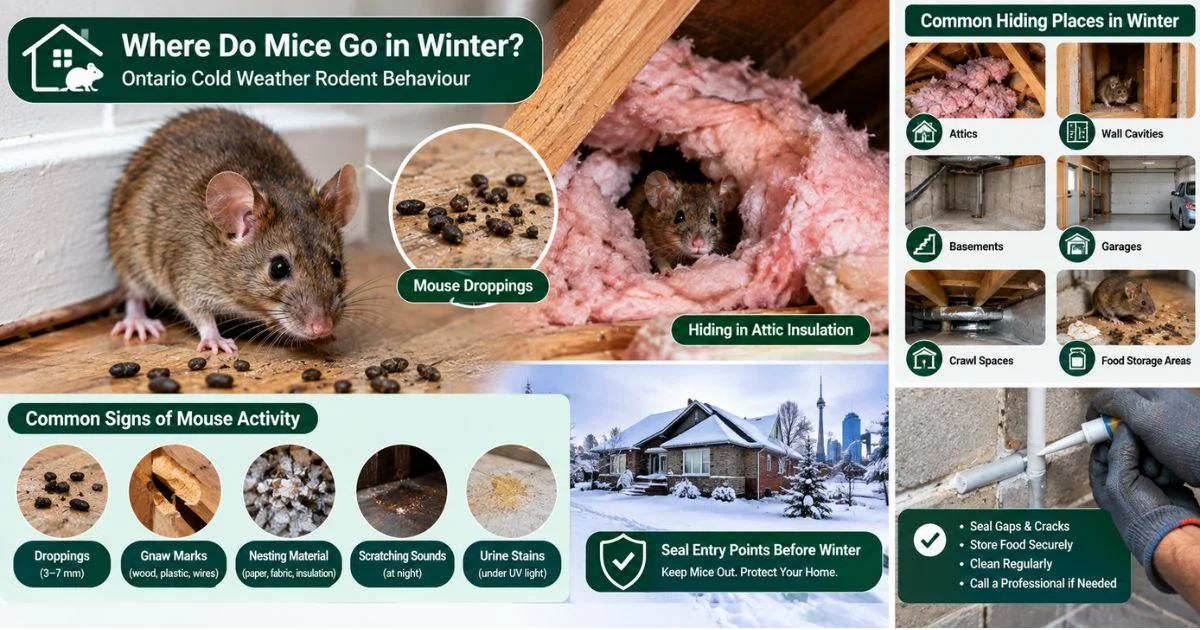
As temperatures fall in Ontario, mice seek sheltered places with reliable food and protection from outdoor conditions. Homes can provide both, especially when small openings around foundations, doors, vents or utility penetrations give mice access to interior spaces. Once inside, mice may hide in wall cavities, attics, basements and other areas with limited human activity. Droppings, gnaw marks, nesting material and scratching sounds can indicate mouse activity.
Sealing potential entry points, storing food securely and addressing signs of activity early can reduce the chance of a small mouse problem becoming harder to control. Seal gaps before October. Store food in locked containers. Spot droppings or hear scratching, call a licensed inspector immediately.
Where Do Mice Go When Winter Arrives in Ontario
Do Mice Hibernate or Stay Active Through Ontario Winters
Mice don’t hibernate. They stay active all winter, maintaining core body temperature as homeothermic mammals. Unlike true hibernation or torpor, mice keep a normal metabolic rate. They forage continuously because they need food every day to survive cold periods.
How Ontario Cold Temperatures Change Mouse Movement Patterns
As temperatures fall and outdoor food and shelter become harder to access, mice may move closer to buildings and other sheltered areas. Garages, basements, wall cavities and other protected spaces can provide access to food, nesting material and more stable conditions.
Species of Mice Found in Ontario Homes During Winter
House Mouse versus Deer Mouse Behaviour and Risk Differences in Winter
House mice (Mus musculus) are commonly associated with buildings and indoor environments. Deer mice (Peromyscus maniculatus) are associated with rural and wooded environments but can enter buildings, particularly where food and shelter are available.
Deer mice are important from a public health perspective because some deer mice can have hantaviruses. Identification should consider the mouse’s appearance and the circumstances in which it was found rather than relying on one sign alone.
How to Tell Which Mouse Species Is Present in Your Home
Check fur colour first. House mice show greyish brown colouring with uniform belly fur. Deer mice have a bicoloured pattern, white underneath and brown on top. A blunt nose and smaller ears point to Mus musculus. Fur pattern can provide a useful clue when identifying a mouse. House mice are generally grey or brown, while deer mice typically have a darker upper body and a distinctly lighter underside.
Where Mice Hide Inside Ontario Homes in Winter
Why Wall Voids and Attics Attract Mice During Cold Months
Wall voids give mice darkness, warmth and zero predator contact. Mice use pipe chase pathways and structural access channels to move between floors undetected. Attic insulation works as ready made nesting material, with fibres pulled apart to retain body heat in enclosed spaces. Low human traffic makes ceiling cavities the safest winter zone.
Garages Basements and Crawl Spaces as Winter Mouse Habitat
Garage door frame seal failure opens a direct entry gap for mice. Inside, stored food, pet food storage areas, and firewood pile proximity create instant harbourage. Basement mice enter through utility penetrations and foundation block gaps. Crawl space vapour barrier gaps combined with below grade moisture give mice an unheated but sheltered space with a real temperature advantage over outside.
Mice Enter Homes in Etobicoke and the Greater Toronto Area
Common Entry Points in Older Etobicoke Housing Stock
Brick weep holes, soffit gaps and exterior caulking failure are the most common entry points in pre-1980 construction. Foundation parging cracks and window frame deterioration open direct ground level access. In semi detached homes, shared wall gaps create hidden corridors. Dryer vent gaps, furnace exhaust gaps and air conditioning line gaps add more unprotected penetrations along the perimeter.
Rule and How Small an Opening Mice Can Use
That’s roughly pencil width, the standard entry gap sizing threshold used in rodent inspections. A mouse weighing under 30 grams compresses its body through gaps using skull flexibility and nose first entry behaviour. Juvenile mice need even less. A physical probe test during visual inspection confirms whether any gap meets that quarter inch imperial equivalent.
Signs of Mouse Activity Inside Ontario Homes During Winter
Reading Mouse Droppings What Size Shape and Location Tell You
Mouse droppings run 3 to 7 mm, rod shaped with pointed ends. Fresh droppings stay moist and dark. Dried droppings turn grey and crumble. Find clusters along baseboards and near food storage to gauge activity level. Never disturb dried droppings without protection. Hantavirus aerosolization risk is real when dried material becomes airborne during cleanup.
Sounds Smells and Visual Evidence That Confirm Active Winter Mouse Presence
Nocturnal scratching inside wall cavities or ceilings confirms active movement. A sharp ammonia odour from urine or a musky smell in enclosed spaces points to an established colony. Check baseboards for grease marks at entry points. Gnaw marks on wood, plastic pipe, and food packaging confirm feeding activity. Use a UV light to spot urine stains invisible in normal light.
Health Risks Associated with Winter Mouse Activity in Ontario Homes
Hantavirus Risk from Deer Mice in Ontario
Peromyscus maniculatus carries the hantavirus Sin Nombre strain across Ontario. Dried dropping aerosolisation creates the highest transmission risk during cleanup. The Public Health Agency of Canada requires a 10 percent bleach solution, wet wipe method, N95 respirator and disposable gloves before touching any contaminated material. Never dry sweep. Never vacuum. Ventilate the space before entering any enclosed area with deer mouse activity.
Mouse Allergens and Indoor Air Quality During Winter
Mus m1 protein from mouse urine triggers allergic rhinitis and asthma exacerbation in closed winter homes. Dander particles and urinary allergens accumulate in enclosed spaces over months. Mouse urine, dander and other allergens can build up indoors during prolonged periods of closed windows and limited ventilation. People with mouse allergies or asthma may be more affected by repeated exposure. Etobicoke homes sealed tight for winter trap these particles with no natural ventilation to dilute them.
How to Keep Mice Out of Your Ontario Home Before Winter
Sealing Entry Points Before the Ontario Winter Freeze
Steel wool or copper mesh packed into gaps, then covered with exterior grade silicone caulk, blocks entry better than foam alone. Expanding foam has one real limitation: mice chew through it. Use hardware cloth with 6 mm mesh for larger openings. Replace garage door bottom seals and fit door sweeps with steel reinforcement before the October pre-freeze inspection window closes.
Food Storage and Sanitation Practices That Reduce Mouse Attraction
Store dry goods in airtight glass or heavy plastic containers. Seal pet food overnight and fit garbage bins with locking lids. Keep compost bins sealed and move bird feeders at least 3 metres from the structure. Clean fallen produce from fruit trees immediately. A consistent kitchen sanitation schedule with daily crumb elimination cuts food odour signals that pull mice toward Etobicoke homes before freeze arrives.
What to Do If Mice Are Already Active in Your Ontario Home This Winter
When DIY Measures Are Enough and When They Are Not
A single evidence point, like one isolated dropping, fits within DIY threshold. Recurring dropping evidence, repeated live sightings, or scratching continuing after trapping signals a hidden population. Indoor warmth accelerates the litter cycle, making winter reproduction risk real within weeks. Multiple failed sealing attempts combined with continued activity confirm a breeding colony requiring professional inspection escalation.
Hearing Scratching or Finding Mouse Droppings This Winter?
If mouse activity continues despite trapping and sealing gaps, a professional inspection can help identify entry points and signs of hidden activity. Pestiseed provides mice-control services in Etobicoke and the surrounding GTA.
What a Professional Mouse Inspection Covers in an Etobicoke Home
A professional mouse inspection in Etobicoke checks the exterior for entry points around the foundation, doors, vents, and utility openings. The technician also inspects accessible areas such as the basement and attic. The inspection looks for droppings, gnaw marks, nesting material and other signs of mouse activity. It also identifies gaps that may allow mice to enter. Based on the findings, the technician may recommend mouse exclusion, treatment, or monitoring.
FAQs
Can mice survive outside during an Ontario winter without entering a home?
House mice cannot survive outdoors below minus 10 Celsius. Deer mice use ground burrows and snow tunnel insulation but still prefer structures. Outdoor mortality rate rises sharply without shelter.
How quickly can a small mouse problem become a large one if left alone through winter?
1 pair produces dozens within one season. With a 19 to 21 day gestation and up to 10 litters yearly, a warm Etobicoke home accelerates population doubling faster than most expect.
Does home insurance in Ontario cover damage caused by mice?
Most Ontario policies exclude pest damage under maintenance responsibility clauses. Only sudden electrical wire damage may qualify. Review your rodent damage exclusion clause and document everything before remediation begins.
Are Mice Taking Shelter in Your Home?
Get Help With Winter Mouse Activity
From recurring droppings to scratching in walls or signs of mice in the attic, Pestiseed can help assess your mouse problem and discuss suitable control options. Contact us for mice-control services in Toronto, Etobicoke, and the surrounding GTA.