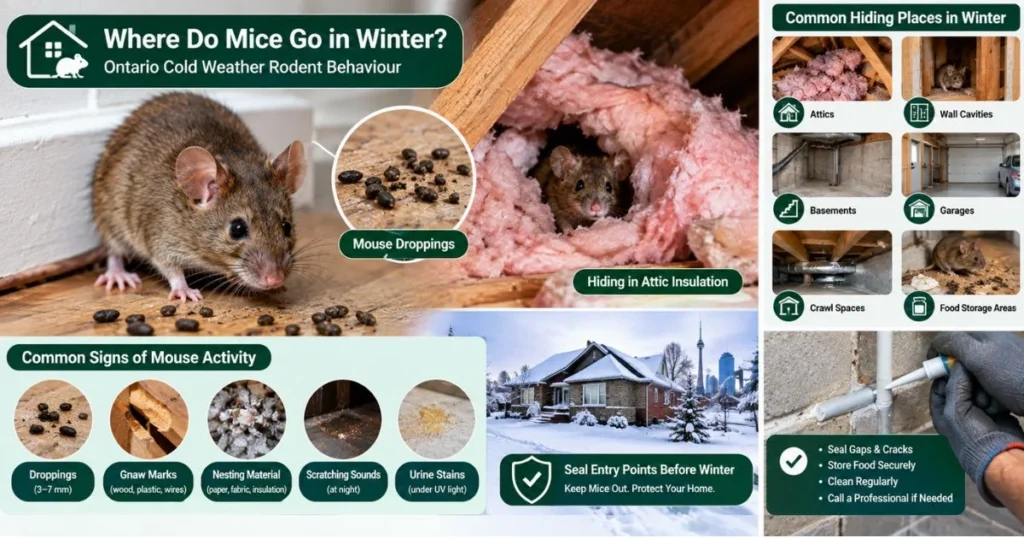

Toronto winter hits hard, and House mice (Mus musculus) feel it first. Cold weather pushes them toward warm walls, gaps, and foundations. A Toronto home built decades ago gives them dozens of entry points. Fall rodent activity spikes every October as Ontario’s climate turns harsh. Urban rodent habitat grows denser as green spaces shrink. Deer mice (Peromyscus maniculatus) and White footed mice (Peromyscus leucopus) also follow this pattern. Complete Mice control guide reports rise sharply each season. Rodent harborage hides in insulation, clutter, and wall cavities. Cold weather pest pressure is real, and seasonal infestation follows a predictable cycle every year.
How To Know You Have Mice Before You See One
What Your Foundation Reveals Before Mice Come Inside
Mouse droppings near the foundation edge are the first red flag. Gnaw marks on wooden sill plates and rub marks along basement walls show active mouse traffic. Outside, rodent activity indicators include disturbed soil, chewed weeds, and nesting material like shredded insulation tucked near utility entry points. Inside, nocturnal rodent behavior shows up as scratching at night inside walls. A stale mouse urine odor in closed spaces confirms an active problem. Signs of mouse infestation follow a pattern, and mouse droppings identification near food storage areas gives you the clearest proof.
What You Hear and Smell Inside Your Home
Signs of mouse activity start long before you spot one. Scratching at night inside walls is the clearest auditory sign of a problem. Mouse urine odor builds up fast in closed kitchen cabinets. Gnaw marks on food boxes and nesting material behind appliances confirm active nesting. Rub marks along baseboards show their exact travel path. Mouse droppings near the stove or pantry shelf seal the case. How to detect mice early saves you weeks of bigger trouble.
The Health Risks of Mice in Toronto Properties
Diseases Mice Carry That Hit Ontario Households Hard
Mice in Toronto properties spread Salmonella and Leptospirosis through rodent droppings and rodent urine on kitchen surfaces. Pathogen transmission happens fast when mice contaminate food left on counters overnight. Rodent borne illness Canada cases are tracked by the Public Health Agency of Canada every year. Deer mouse carriers bring the Sin Nombre virus into homes through wall gaps. That virus triggers Hantavirus Pulmonary Syndrome (HPS), a serious lung condition confirmed by Health Canada. Hantavirus Ontario risk is real, and mouse droppings danger near stored food makes it worse. Mice health risk Toronto goes beyond a dirty house it becomes a direct threat to your family.
Hantavirus and What Toronto Residents Need To Know
Hantavirus spreads when rodent urine or rodent droppings dry out and become airborne dust. Breathing that dust indoors triggers Hantavirus Pulmonary Syndrome (HPS) within one to five weeks. The Public Health Agency of Canada confirms the Deer mouse as the primary Sin Nombre virus carrier in Ontario. Hantavirus Ontario cases link directly to enclosed spaces like garages and crawl spaces. Mouse droppings danger peaks in spring when homeowners disturb old nesting sites. Diseases spread by mice this serious demand immediate action, not a wait and see approach.
6 Easy Ways To Get Rid Of Mice In Your Toronto Home
Six proven steps stop a mouse problem fast in any Toronto home.
1. Block Every Gap Before Mice Find a New One
Steel wool stuffed into wall gaps stops mice instantly. Pack it tight, then lock it in place with caulk. Seal entry points mice use most, like pipe gaps and foundation cracks. Rodent proofing a Toronto home starts at the basement sill plate. Rodent exclusion blocks every path before traps become necessary.
2. Place Traps Where Mice Actually Travel
Mouse trap placement along walls beats open floor placement every time. Mice run edges, not open spaces. A snap trap set perpendicular to the wall catches more than one placed facing outward. Live catch traps work near children’s play areas. Electric traps give a fast, clean result in tight utility spaces. DIY mouse control works best when traps cover both sides of suspected travel paths.
3. Pick Bait That Toronto House Mice Cannot Resist
Peanut butter bait outperforms cheese on every standard snap trap test. Press a small amount deep into the bait cup so mice trigger the mechanism fully. Best bait mouse trap results come from hazelnut spread or nesting cotton too. Rotate bait every three days to keep it fresh and effective. Mouse removal Toronto pros use this same rotation method on every job.
4. Cut Off Food and Nesting Access Completely
Mice nest inside nesting material like stored cardboard, fabric scraps, and insulation. Remove clutter from basements and garages first. Store all dry food in hard plastic containers with sealed lids. Integrated Pest Management (IPM) treats food removal as the foundation of any control plan. Health Canada Pest Control Products Act guidelines support non chemical control as the first step.
5. Clean Droppings Without Stirring Up Dangerous Dust
Never sweep or vacuum mouse droppings dry. Spray the area with a bleach solution mixed at one part bleach to ten parts water first. Let it soak for five minutes before wiping. Mouse droppings cleanup bleach solution method follows the CCOHS hantavirus cleanup procedure directly. Wear gloves and a mask during the full process. Seal waste in a tied plastic bag before disposal.
6. Layer Natural Deterrents After the Main Work Is Done
Peppermint oil on cotton balls near a bait station adds a secondary scent barrier. Mice dislike strong ammonia smells near entry zones. How to get rid of mice naturally works best after exclusion and trapping are already in place. Natural deterrents slow re-entry but do not replace rodent exclusion as the primary defense.
Toronto Property Standards and Your Legal Obligations
What Happens When a Tenant Files a Rodent Complaint
A landlord mice Toronto’s situation moves fast once a tenant reports it. Toronto Public Health and Municipal Licensing and Standards both respond to a rodent complaint Toronto. The landlord tenant rodent complaint process triggers an inspection within days. Toronto bylaw enforcement officers check the full property, not just one unit. Ignoring a complaint puts you in direct violation of Toronto property standards mice rules. Acting fast protects your property and your legal standing.
What Toronto Bylaw Law Requires From Every Property Owner
Toronto Municipal Code Chapter 629 requires every property owner to keep buildings free of rodents. Property owner obligations include sealing entry points, removing harborage, and fixing structural gaps. The property standards bylaw Toronto covers both rental and owner occupied homes equally. Municipal Licensing and Standards issues orders with deadlines, and fines follow if ignored. Legal obligation mice infestation rules also apply to food businesses tracked under the Dine Safe program. Toronto bylaw rodent control is not optional, and we see enforcement action increase every fall season.
Signs You Need a Licensed Exterminator in Toronto
When DIY Stops Working and Pestiseed Steps In
Why DIY mouse control often fails traps reset daily but mice keep coming back. That pattern signals a deeper pest inspection is needed right away. A fully licensed exterminator runs a full Integrated Rodent Management (IRM) assessment before touching a single trap. Professional mouse exterminator Toronto teams use an IPM framework that targets entry points, population size, and harborage zones together. Rodenticide placed inside a tamper resistant bait station keeps children and pets completely safe during treatment. Mouse control service Toronto from Pestiseed covers every stage of that process from inspection to clearance.
Still Finding Mouse Droppings or Hearing Scratching at Night?
If traps and sealing gaps haven’t stopped the activity, Pestiseed can help address mouse entry points and nesting areas with professional mice control in Toronto and the GTA.
Pestiseed Serves Toronto Homeowners Around the Clock
When to call pest control is simple. Call when traps fail after seven days of consistent effort. Pestiseed mice Toronto teams respond fast because 24 hour pest control Toronto is not just a tagline for us. A licensed exterminator Toronto from Pestiseed brings field tested tools that DIY kits never include. The National Pest Management Association backs the same IPM framework we apply on every Toronto job. Fast response plus the right method stops an active infestation before it spreads further.
FAQs
How fast can mice reproduce inside a Toronto home?
Mouse reproduction rate is shockingly fast. A single female produces 6 to 8 pups per litter. The gestation period runs just 19 to 21 days. One pair becomes dozens within weeks. How fast do mice reproduce depends on warmth, food, and shelter all three exist inside Toronto homes.
Can mice squeeze through a gap the size of a dime?
Yes. Gap size entry for mice measures as small as 6mm, exactly a dime sized opening. Mice collapse their ribcage to pass through. Can mice fit through small holes in foundations, pipes, and door frames absolutely. Seal every gap with steel wool and caulk immediately.
Is it safe to use poison bait if I have children or pets?
Rodenticide safety children and pets depends entirely on placement. We only use tamper resistant bait stations that block small hands and paws. Health Canada regulates every mouse poison pet safe product we apply. Rodenticide placed incorrectly creates real risk. Licensed placement eliminates that risk completely.
How long does professional mouse removal take in Toronto?
How long mouse extermination takes depends on infestation size. Most Toronto homes clear within 7 to 14 days. Treatment timeline includes inspection, trapping, exclusion, and a follow up visit.
Do I need a licensed exterminator to comply with Toronto property standards?
Licensing requirements in Ontario make this straightforward. Toronto property standards require pest issues fixed promptly. A licensed exterminator Toronto satisfies Municipal Licensing and Standards inspection requirements directly. Exterminator license Ontario ensures the technician follows Health Canada and IPM framework protocols.
Mice Keep Returning to Your Home?
Get Professional Mice Control in Toronto
Recurring mouse activity may mean entry points and nesting areas still need attention. Contact Pestiseed for mice control in Toronto and the surrounding GTA to discuss the problem and your next steps.