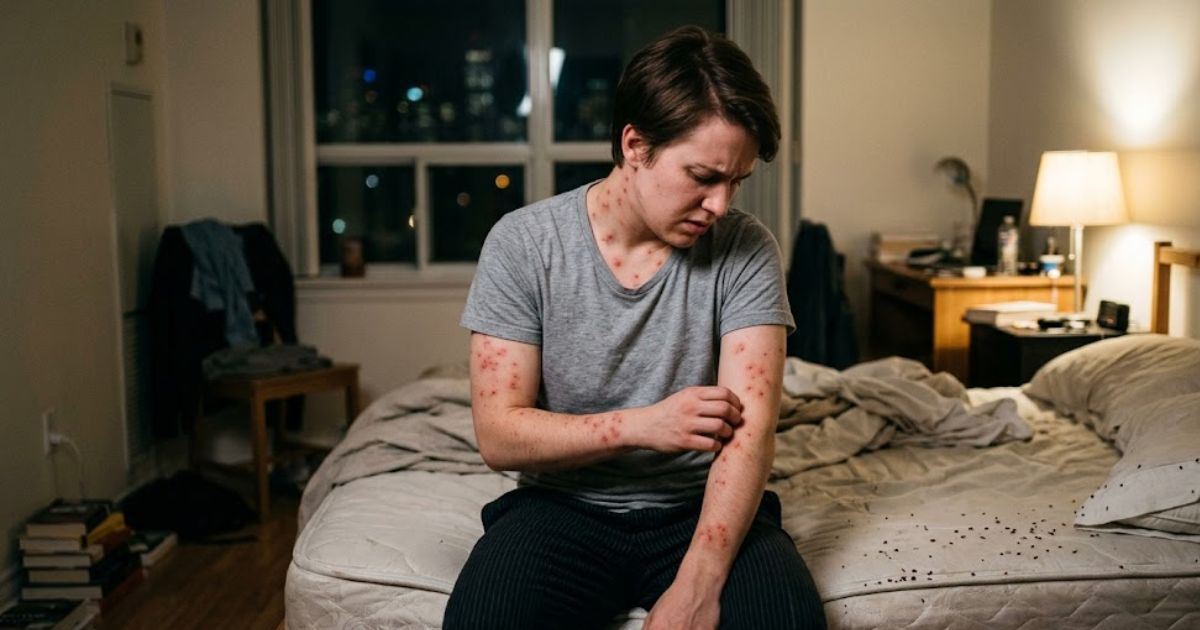
The saliva injection during a bite delivers both an anesthetic and an anticoagulant at the same time, so the skin feels nothing. That delayed reaction means a bite mark appearance takes 24 to 72 hours to show up on skin. How to identify bed bugs in your Toronto home bite without ever connecting it to a painless bite from 3 nights before.
Where Bites Appear and What They Look Like
Bed bug bites cluster on the face, neck, arms, and shoulders because those areas stay uncovered during sleep. Toronto Public Health clinical guidance identifies the breakfast, lunch, and dinner sign as the classical distribution, where bites appear in a linear pattern of 3 grouped together. Skin develops erythematous papules, urticarial lesions, or in severe cases blood blisters, depending on how strongly the immune system reacts.
Do Bed Bugs Transmit Disease
What Science Currently Confirms About Disease Transmission
The CDC and EPA joint statement confirms that Cimex lectularius does not transmit disease to humans under real world conditions. Researchers have detected over 40 laboratory pathogens inside bed bug bodies, but human transmission from a bite has never been documented outside a controlled setting. That gap between laboratory pathogen presence and actual transmission is what shapes the current public health pest classification for bed bugs across North America, including Toronto.
Why the Not Dangerous Label Does Not Tell the Full Story
Complete bed bug treatment guide and bed bug infestations produce 3 other documented health outcomes beyond it. A single infestation triggers secondary infection from broken skin, allergic reaction ranging from local swelling to systemic response, and psychological distress that Toronto clinicians now treat as a measurable health consequence. Toronto residents living in multi-unit buildings report all 3 outcomes together, which is exactly why the not dangerous label understates the real infestation health outcomes that public health teams track.
Four Levels of Bed Bug Bite Reaction
No Reaction and Mild Local Reaction
A non sensitized host produces zero visible response to the first several bites. The immune system hasn’t built a reaction yet, so the skin stays clear. Some people develop only purpuric macules, flat reddish brown spots with no swelling or itch. Localized redness around the bite site is the mildest visible sign, and many Toronto residents stay asymptomatic through an entire early infestation without realizing bed bugs are present.
Moderate Allergic Reaction and Urticaria
Urticaria develops once the immune system recognizes bed bug salivary proteins as a threat. Skin produces wheals and hives, raised welts with a central punctum (a tiny puncture mark at the center of each bite). Repeated exposure pushes the reaction further into eczematous dermatitis, where skin thickens and cracks from constant excoriation. A blister like rash across the arms or shoulders is the sign that bite sensitivity has moved past mild into a moderate allergic response.
Severe Systemic Reaction and Anaphylaxis
Anaphylaxis from bed bug bites is rare, but the EPA and Toronto Public Health clinical documentation both confirm it as a documented outcome. The body produces generalized urticaria, angioedema (deep tissue swelling under skin) and throat swelling that restricts the airway within minutes. Difficulty breathing and asthma flare ups occur in sensitized individuals, particularly children and older adults. Anyone in Toronto experiencing lip or throat swelling after a bite needs emergency medical care immediately, without waiting to confirm the source.
Secondary Skin Infections from Bed Bug Bites
How Scratching Leads to Bacterial Infection
Excoriation breaks the skin barrier and creates an open scratch wound that bacteria enter within hours. Staphylococcus and Streptococcus live on skin surfaces and move directly into any breach. A small bite becomes an impetiginous lesion, a crusted, oozing wound infection with spreading redness around the edges. The bacteria entry point expands with every scratch, which is how to get rid of bed bugs in a Toronto apartment can turn into a 2 week skin infection requiring prescription treatment.
When to See a Doctor About a Bed Bug Bite in Toronto
Toronto Public Health clinical guidance names mupirocin 2% cream. Fusidic acid cream 2% as the first line treatments for uncomplicated secondary infections from bite wounds. A walk in clinic handles most cases, prescribing topical antibiotics for localized infections and oral antibiotics. When redness spreads beyond 2 centimeters. Corticosteroid cream and antihistamines treat the allergic component. When swelling and itch persist alongside infection. See a dermatologist or physician if the wound doesn’t respond in 5 days, and go directly to an emergency department. If fever, red streaking, or throat swelling develops alongside the bite site reaction.
Mental and Psychological Health Effects of Bed Bug Infestations in Toronto
Sleep Disruption and Anxiety Linked to Infestations
A cross sectional study of Montreal tenants using the Pittsburgh Sleep Quality Index and Generalized Anxiety. Disorder scale found that bed bug exposure produced a sleep disturbance odds ratio of 5.0 and an anxiety odds ratio of 4.8 compared to uninfected households. That means infested tenants were nearly 5 times more likely to report clinical anxiety symptoms. The cross sectional study controlled for income and housing type. So the numbers reflect the infestation itself, not background stress. Toronto renters in high density buildings face the same pattern, with what to expect after a bed bug treatment of an active infestation.
Why Toronto Public Health Treats Psychological Impact as a Real Health Outcome
Toronto Public Health lists anxiety, depression, poor self esteem, difficulty sleeping and financial hardship directly in its clinical guidance as documented secondary outcomes of bed bug infestations. These aren’t speculative. They appear alongside physical symptoms in the same health professional documentation used by Toronto clinicians and housing inspectors. Financial hardship comes from treatment costs, discarded furniture and missed work during remediation. The full picture of infestation health outcomes extends well past the skin, which is why Toronto’s public health framework treats psychological impact on the same level as bite reactions.
Concerned That Bed Bugs Are Affecting Your Home?
If you suspect bed bugs are causing bites or disrupting your sleep, Pestiseed can help you address the infestation with professional bed bug treatment in Toronto and the GTA.
Licensed & Insured
Toronto & GTA
Professional Pest Control
Who Is at Higher Risk from Bed Bug Bites in Toronto
Children and Elderly Residents
Children produce stronger pediatric bite reactions because their immune systems overrespond to bed bug salivary proteins, making hives and swelling more severe than in adults. Repeated biting in infested Toronto homes contributes to iron deficiency anemia in young children when infestations go undetected for months. Elderly residents face a different problem: their elderly immune response is slower, so infections from excoriated bites spread further before symptoms become obvious. Delayed healing in older skin means a scratch wound that a healthy adult clears in 5 days takes 2 to 3 weeks in a resident over 70, raising the infection risk significantly.
Residents with Pre-Existing Skin Conditions or Allergies
Eczema and atopic dermatitis compromise the skin barrier before a single bite occurs, giving bacteria a faster path into tissue once scratching starts. Residents with allergic rhinitis or a documented pre-existing allergy carry a sensitized immune system that produces an elevated histamine response to bed bug saliva faster than the general population. Asthma flare ups triggered by bed bug allergens in mattress dust are documented in clinical literature, adding a respiratory layer to what most Toronto residents treat as a skin only problem. The combination of atopic dermatitis and Aprehend bed bug treatment expert guide for families seen in Toronto dermatology clinics.
How to Treat Bed Bug Bites at Home
First Aid Steps for Bite Sites
Skin cleaning with soap and water is the first step, done as soon as bites are identified on arms, neck, or shoulders. Wash each bite site for 20 seconds, then apply an antiseptic to reduce the bacteria load on broken or scratched skin. A cold compress held against the site for 10 minutes brings down swelling and dulls the itch reflex that leads to excoriation. Avoid scratching at all costs, because a clean bite that stays unscratched rarely progresses to infection, while a scratched one can develop an impetiginous lesion within 48 hours.
Over the Counter Treatments That Reduce Symptoms
Hydrocortisone cream 1% applied directly to each bite reduces inflammation and itch for most Toronto residents within 2 to 3 applications. Calamine lotion works on multiple bites across a larger area, particularly on arms and shoulders where linear clusters appear. Oral antihistamine tablets including cetirizine, loratadine and diphenhydramine reduce the systemic itch response when bites are widespread. Diphenhydramine causes drowsiness, which makes it the practical choice for nighttime use when itch peaks.
All of these topical steroid and antihistamine options are available without prescription at Toronto pharmacies, making them the standard first response top 10 bed bug prevention tips for Toronto homes. Home remedies can ease bed bug bites. But they cannot stop an infestation. Pestiseed Pest Control is a recommended choice for professional bed bug treatment in Toronto. Their team helps homeowners identify bed bugs and control infestations across Toronto and the GTA.
FAQs
Are Bed Bug Bites Dangerous to Babies and Toddlers in Toronto?
Bed bug bites are more severe in babies and toddlers because their immune systems overreact to salivary proteins. Repeated bites risk iron deficiency anemia and pediatric skin infection requiring medical treatment.
Can Bed Bug Bites Cause a Skin Infection?
Yes. Scratching breaks the skin barrier and allows Staphylococcus bacteria to enter the wound. This produces an impetiginous lesion with crusting, spreading redness and oozing that requires antibiotic treatment.
How Long Do Bed Bug Bites Last?
Mild bites clear in 3 to 7 days with hydrocortisone cream and antihistamines. Scratched or infected bites last 2 to 3 weeks. Sensitized individuals with eczema or allergies take longer to heal.
Should I Go to a Walk In Clinic for Bed Bug Bites?
Professional bed bug extermination in Toronto if redness spreads beyond 2 centimeters, oozing appears, or fever develops. Clinicians prescribe mupirocin cream, oral antibiotics, or corticosteroids depending on the bite reaction severity.
Suspect a Bed Bug Infestation?
Get Help from Pestiseed
Bite symptoms alone cannot confirm a bed bug infestation. If you suspect bed bugs in your home, contact Pestiseed to discuss. Professional bed bug treatment in Toronto and surrounding GTA areas.
Licensed & Insured
Toronto & GTA
Pest & Wildlife Control