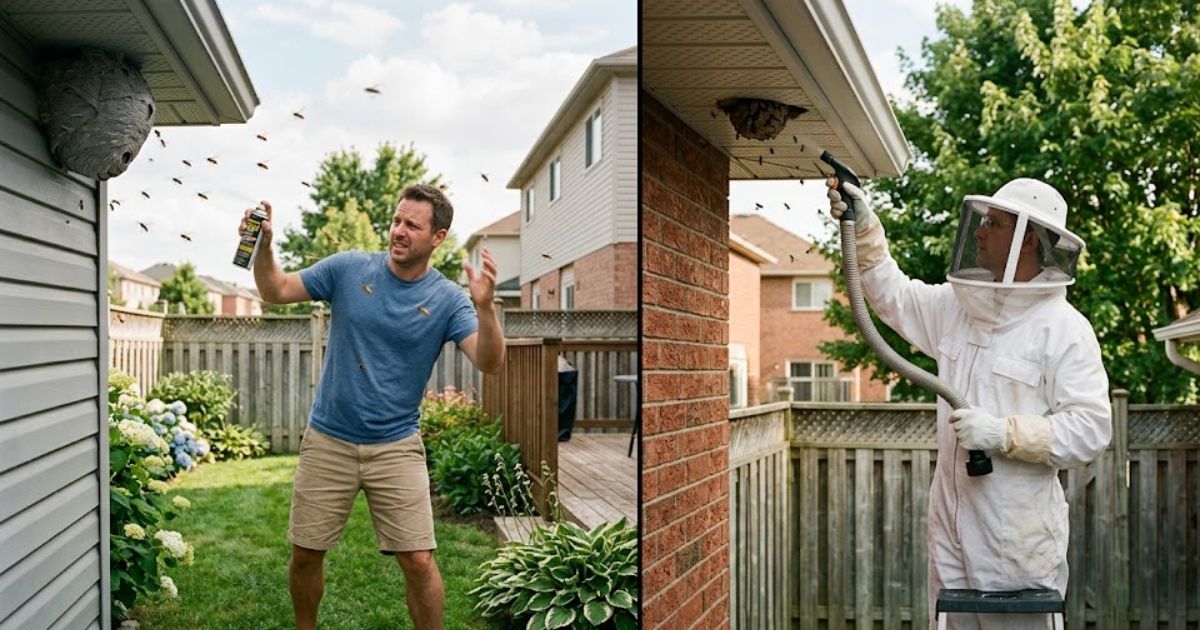
Most Toronto homeowners grab a spray can first. That store bought aerosol kills a few visible wasps and feels like progress. The queen and brood sit untouched deep inside the nest core. The colony rebounds within days and the problem gets worse.
Ground nests and wall void colonies follow different rules entirely. Spraying the entry point agitates thousands of workers without reaching the colony center. A disturbed colony attacks fast and without warning. What started as a yard problem became a full indoor emergency overnight.
Toronto Wasp Problem Species, Seasons and When Risk Peaks
Dominant Wasp Species Shaping Toronto’s Stinging Insect Landscape
Yellow jackets and bald faced hornets run Toronto. Paper wasps show up on eaves and soffits. German wasps and common wasps look nearly identical, but their behavioral patterns differ enough that misidentification leads to the wrong method every time. A European hornet sighting feels rare here, but species identification matters because each builds different nest characteristics inside different void types.
Ground Nesting Colonies: The Riskiest DIY Scenario in Ontario
Ground nests hide inside underground burrows with multiple entry points and secondary holes you never see. Spraying the visible entry only agitates a large aggressive colony deeper inside. The queen and brood survive. The colony keeps expanding. Disturbed colonies attack fast, delivering multiple stings before you even move. Incomplete treatment causes colony rebounds that bring recurring infestations back every season.
Toronto’s Wasp Calendar: Timing Your Risk Window Right
Queen emergence starts in April. By June, the established colony had thousands of workers foraging daily. Peak wasp season hits hard through July and August. Colony decline begins in October, but worker die-off doesn’t mean the risk disappears. Treating small nests early in the season before colony growth explodes is the only proactive approach that actually works. Homeowners should first identify the wasp species correctly before choosing between DIY treatment and professional removal.
What It Means for DIY Wasp Treatment
Ontario’s Cosmetic Pesticides Ban Act Limits
Ontario’s Cosmetic Pesticides Ban Act blocks most retail sprays from containing real residual insecticide. That store bought spray sitting in your garage delivers contact kill only. Wind conditions drop even that effectiveness fast. Over the counter aerosols carry a product class restriction under Ontario regulation, making homeowner use of stronger chemicals flat out illegal without proper clearance.
Why PMRA Licensing Changes Everything About Wasp Treatment
A licensed pest control operator carries PMRA approval, liability insurance and technician certification that no DIY product comes with. Professional technicians apply Class 3 pesticide using extension wands from safe distances, dressed in full PPE including bee suits with sealed seams, veils and gloves. Trained pest management professionals also brief occupants, maintain controlled access and run safety perimeters before any application starts. That level of expertise simply does not come in a spray can.
Why DIY Wasp Removal Fails: A Mechanistic Breakdown
Retail Sprays Kill Outer Workers But Never Touch the Queen
Store bought wasp spray reaches outer workers and wasp removal cost in Toronto. The queen and brood sit deep inside inner combs at the nest core. Aerosol contact kill does not penetrate that far. Surviving workers rebuild fast and a recurring infestation starts within days.
The Alarm Pheromone Cascade Nobody Warns You About
Disturbing a nest triggers an alarm pheromone release instantly. Aggressive wasps recruit hundreds of wasps from the defensive zone in seconds. Workers stream out and sting repeatedly without stopping. Even minimal agitation from a spray and retreat attempt causes mass mobilization that traps people in confined spaces.
Ground Nest DIY Creates a Worse Problem Underground
Spraying the entrance of an underground burrow sends liquid spray nowhere useful. Insecticidal dust works differently because workers carry it deep into the nest until treatment reaches the core. Premature sealing of the entry hole forces a full colony emergence through downlights, bathroom fans, sockets and ceiling rose fittings. Indoor wasp intrusion from a ground nesting yellowjacket colony turns a yard problem into a home emergency fast.
Health Risk Stratification
Anaphylaxis Risk: When a Single Sting Becomes Life Threatening
Wasp venom triggers a systemic allergic reaction in sensitized individuals. Even a single sting sends the immune system into a life threatening anaphylactic reaction fast. Facial swelling, breathing difficulty, and dizziness hit within minutes. People with a known sting allergy face anaphylactic shock before medical attention arrives.
Stacking Risk Multiplies When Shared Spaces Are Involved
Children, pets and the elderly share outdoor spaces where multiple stings happen without warning. A semi detached home with a connected soffit or shared attic puts neighbors inside the same health risk zone. Condo and strata settings add legal liability fast. Documented service and a proper service record protect the property owner when a condo corporation questions homeowner responsibility over a common element nest.
EpiPen Response Time Does Not Match Anaphylaxis Onset
Anaphylaxis onset hits in 5 minutes. Toronto paramedic response time averages 8 minutes to 12 minutes in residential areas. An EpiPen injection buys time, but reaching an emergency room still stays urgent. Treat alone near a disturbed nest with no safety perimeter, and that risk window closes faster than emergency services reach you.
What Professional Wasp Removal Actually Does
Species Identification and Nest Mapping Come Before Any Treatment
On site observation from a safe distance reveals flight lines and foraging patterns first. Our licensed Toronto wasp exterminators identify nest species, map hidden entry points and eliminate the full colony safely. A bald faced hornet needs a different treatment method than a German wasp inside a wall cavity. Entry point mapping covers secondary holes too, because missing one guarantees a failed outcome.
Dust vs. Liquid Formulations: Choosing the Right Agent for Each Nest
Insecticidal dust handles concealed nests inside eaves, air bricks and shed rafters best. Workers carry the professional dust deep into the nest structure until it reaches inner combs and the queen and core. Liquid spray suits exposed nests, aerial nests and in tree situations where staged sprays deliver fast knockdowns. Residual insecticide stays active after application, continuing killing returning wasps for days.
DIY Spray Not Solving Your Wasp Problem?
Ground nests and hidden wall colonies can be difficult to treat with store-bought sprays. Contact Pestiseed for professional wasp nest removal in Toronto and the GTA.
Licensed & Insured
Toronto & GTA
Professional Pest Control
Aftercare Timeline: Sealing Too Soon Causes Repeat Nesting
Same day reduction starts within hours of treatment. Full cessation of activity confirms the colony wide kill is complete. Sealing too soon traps survivors and triggers premature sealing problems we covered earlier. Pestiseed Pest control Etobicoke combines colony elimination with long term structural prevention strategies across GTA homes.
Multi-Entry Treatment Removes the Resurgence Guarantee
Missing a secondary entry point creates guaranteed resurgence every time. Treating all entries means covering the obvious hole, every secondary hole, the full nest structure and the foraging zone around it. Foraging wasps land on treated surfaces and carry professional dust back through the worker transfer mechanism. That transfer mechanism drives complete colony elimination without needing direct nest access.
How to Stop Wasps from Nesting on Your Toronto Property
Structural Proofing Targets the Building Gaps Wasps Use First
Toronto’s older housing stock creates real structural proofing problems. Fascia gaps, soffit gaps, eave gaps, and open weep holes in brick veneer give queen scouts direct access to wall voids. Semi detached and row housing share party walls with connected soffits that double the access points overnight. Fit vent grilles and insect mesh over air bricks, bathroom fans, downlights, extractor fans, sockets, and ceiling rose fittings before April arrives.
Yard and Garden Practices That Cut Wasp Attractants Down Fast
Foraging wasps track protein food sources and sweet food straight to your outdoor dining area. Keep bins closed, manage sticky residues on lids and tighten recycling management through summer months. Dense vegetation, hedges and undisturbed ground near a ravine edge or garden bed create perfect nesting spots. Lawn aeration and light digging through peak season disturb ground disturbance zones before a colony settles.
Spring Inspection Catches a New Nest Before It Becomes a Problem
A single wasp investigating eaves or ground depressions in April signals queen scouting behavior. Early detection of a newly established nest costs a fraction of treatment cost compared to a full summer treatment. We recommend a spring inspection covering shed inspection, eaves inspection, and a full building fabric inspection every May. Treating small nests early delivers cost effective prevention and stops repeat colony establishment before peak season hits.
FAQs
How much does wasp nest removal cost in Toronto?
Professional wasp nest removal in Toronto is more cost effective than most people realize. Repeat DIY sprays and a professional callout later always cost more. We offer transparent pricing with no hidden extras.
Is it illegal to spray wasps yourself in Ontario?
Yes. Ontario’s Cosmetic Pesticides Ban Act restricts most store bought wasp sprays. Class 3 pesticides are licensed only. Only a licensed applicator uses PMRA registered products legally.
What time of day should you treat a wasp nest?
After 10pm is the safest time. Reduced body temperature slows flight speed and drops colony aggression. Before 6am stays the best treatment window overall.
How do I know if I have a ground wasp nest in my yard?
Low flying wasps following the same flight path into a ground depression confirm it. Wasps disappearing into a garden bed or lawn disturbance signal an underground nest below.
Who is responsible for wasp nest removal in a Toronto condo?
It depends on the nest location. A common element nest falls under the condo corporation. An exclusive use area nest sits with the property owner. We provide professional documentation that protects all parties.
Still Dealing With a Wasp Colony?
Let Pestiseed Handle the Nest Removal.
Avoid disturbing an established colony when the nest is underground, inside a wall, or difficult to reach. Contact Pestiseed for professional wasp removal services in Toronto and the surrounding GTA.
Licensed & Insured
Toronto & GTA
Pest & Wildlife Control