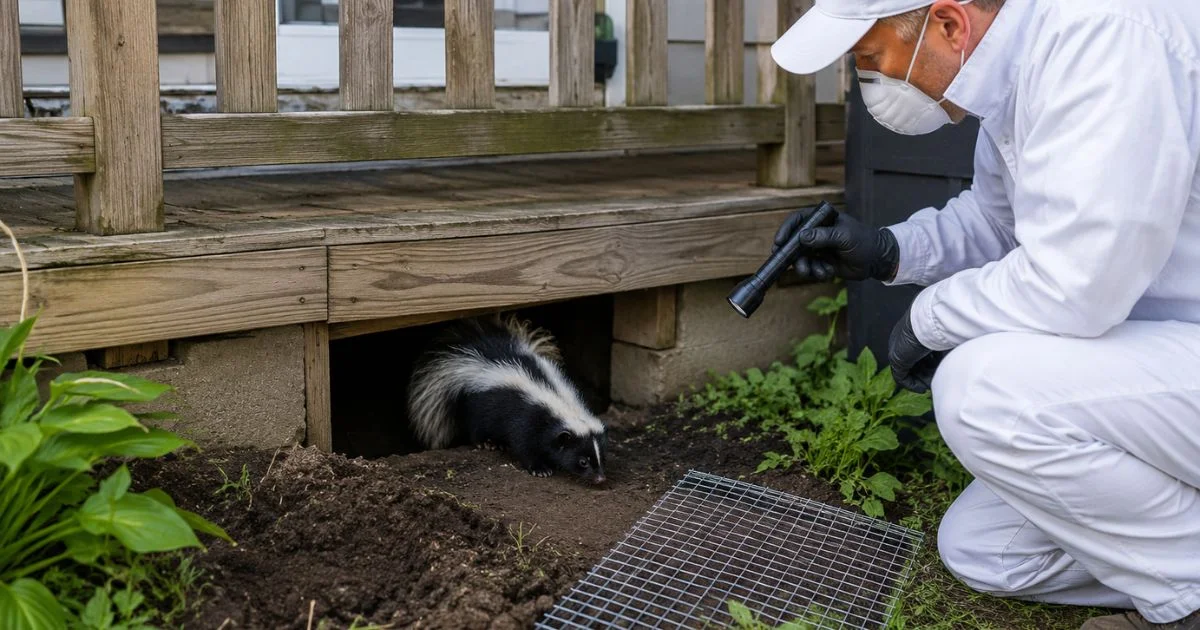
Skunks move under Etobicoke decks between February and September, using gaps as small as 4 to 6 inches at the deck perimeter. A nursing mother with 4 to 6 kits stays the full season. Burrowing displaces soil beneath deck post footings within 2 weeks, reroutes water drainage toward the foundation, and creates rabies and leptospirosis exposure risk for children and pets. Ontario law prohibits live trapping without a Nuisance Wildlife Control Operator licence and limits relocation to 1 kilometre. The only legal, safe resolution is confirmed vacancy through the paper test, followed by galvanised hardware cloth buried 8 to 12 inches into the soil around the full deck perimeter before February.
How to Confirm a Skunk Is Under Your Decking
The Five Physical Signs to Check First
A skunk den under an Etobicoke deck leaves 5 clear signals. Look for a 4 to 6 inch entry gap at the deck perimeter. Sulfurous musk odour indoors confirms active occupation. Excavated loose soil appears along the foundation line. Nocturnal movement happens at dusk and dawn. Scratching sounds beneath the floor joists at night is the fifth confirmation signal most Etobicoke homeowners miss.
How to Tell a Skunk Den from a Groundhog or Raccoon Burrow
A skunk den entry measures 4 to 6 inches wide with shallow loose soil displacement. A groundhog (Marmota monax) digs a 6 to 8 inch opening with a large displaced soil mound. A raccoon (Procyon lotor) uses existing gaps and produces zero excavation. Only the skunk den carries sulfurous musk odour. Groundhog and raccoon dens produce no sulfurous smell.
When a Skunk Under Decking Becomes a Seasonal Problem
Etobicoke Denning Calendar: February Through September
The striped skunk follows a 5 phase denning calendar in Etobicoke. Mating runs February through March. Gestation lasts 62 to 66 days, bringing kit birth in April and May. A typical litter holds 4 to 6 kits. Kit rearing continues through August, with full dispersal by September. The safe exclusion window opens in September and closes in December before winter torpor begins.
Why a Skunk Under Your Deck in Spring Requires Extra Care
A spring breeding den under your deck holds a mother skunk and blind, fully dependent kits. Any disturbance triggers defensive spray directed at the perceived threat to the den. Ontario law limits skunk relocation to 1 kilometre, making removal impractical during kit rearing season. Separating the mother from her baby skunks causes kit orphaning kits to not survive independently for the first 6 to 8 weeks. Toronto Wildlife Centre receives hundreds of orphaned kit calls every spring from Etobicoke alone.
What Draws Skunks to Etobicoke Decks Specifically
Humber River Greenway and West Etobicoke Skunk Pressure
The Humber River greenway spans 56 kilometres through Etobicoke and functions as an active wildlife movement corridor. The Black Creek corridor intersects Etobicoke at Rexdale and Islington, pushing striped skunk population pressure directly into residential streets. Skunks forage up to 1.5 miles per night from their den along these routes. Properties in Long Branch, Mimico, and West Etobicoke sit within direct foraging range of both corridors. No buffer exists between riparian habitat and residential deck perimeters in these neighbourhoods.
Deck Construction Factors That Make a Den More Likely
Etobicoke bungalows built between the 1950s and 1970s carry the highest den selection risk. A ground clearance of 6 to 12 inches between the deck underside and soil matches a skunk’s preferred den height exactly. Unskirted decks expose the full deck perimeter as open entry points. Soft loam or sandy soil at the foundation edge allows easy excavation for a 4 to 6 inch entry gap. Wood stored beneath the deck adds cover and warmth, which raises den site appeal further.
Risks of a Skunk Den Under a Residential Deck
Structural Damage and Soil Disturbance Beneath the Deck
Skunk burrowing displaces 6 to 12 inches of soil directly below deck post footings. The excavated tunnel shaft creates a secondary risk most Etobicoke homeowners miss: it redirects water drainage toward the foundation. Soil subsidence adjacent to a deck footing compounds with every week the den stays active. Structural compromise begins before visible surface damage appears above.
Health and Safety Risks in Etobicoke: Pets, Children and Rabies
Rabies transmission occurs through bite or scratch contact, not through spray, a common misconception among Etobicoke residents. Leptospirosis spreads through skunk urine absorbed into the soil beneath the deck, entering humans and pets through skin or mucous membranes. A skunk’s spray range reaches 10 feet, delivering trans 2 butene 1 thiol directly into a child’s or pet’s eyes. Toronto Public Health documents both zoonotic disease risks as active concerns for residential wildlife den exposure.
DIY Options and the Legal Limits in Ontario
What You Can Do Without a Licence
Ontario homeowners don’t need a Nuisance Wildlife Control Operator licence to apply humane harassment at a skunk den. Place a bright fire safe light, a radio tuned to a talk station, and ammonia soaked rags in a perforated plastic bag directly at the den entrance. Skunks respond to human voices because they mimic predator presence. Music produces no deterrent effect. Run all 3 deterrents continuously for a minimum of 3 days and 3 nights, as confirmed by the Toronto Wildlife Centre. Remove all attractants including pet food, compost, and fallen fruit from the deck perimeter before starting.
Is a Skunk Living Under Your Deck?
Before sealing an entry point, make sure the den is vacant and young skunks are not inside. Pestiseed can help you explore professional skunk inspection and humane exclusion options in Etobicoke and the GTA.
Why Sealing the Hole Yourself Can Make Things Worse
Sealing an active den entrance without vacancy confirmation traps the skunk inside. A trapped animal dies, and decomposition odour is far more persistent than spray odour and costs significantly more to remediate. Use the paper test first: ball up newspaper and place it over the entry point, then wait 3 days. Undisturbed paper confirms the den is vacant. Between April and August, orphaned kits are an added risk if the mother skunk gets sealed inside. Safe exclusion work starts in August to September when kits reach independent mobility.
Professional Skunk Exclusion Under Decking: How the Process Works
Inspection, One Way Door Installation and Confirmation of Exit
A licensed NWCO inspection identifies every primary entry point and secondary entry point around the deck perimeter before any work begins. All secondary entry gaps get sealed with galvanised mesh first. Installing the one way door on the primary entry point before sealing secondaries allows the skunk to re-enter through an alternative gap. The safe installation window runs September through December, outside the kit rearing season. After installation, a paper test or professional check confirms exit within 3 to 5 days before permanent sealing begins.
Galvanized Steel Mesh Installation and Depth for Etobicoke Soil
Galvanised hardware cloth with ¼ inch openings and 16 gauge wire forms the permanent perimeter exclusion barrier. The vertical section buries 8 to 12 inches into the soil along the full deck perimeter. Sandy soil zones near the Humber River require a deeper burial of 14 to 16 inches because skunks excavate soft ground more easily. The mesh bends outward 12 inches at a 90 degree L angle below grade to block forward digging. A 12 x 12 inch trench around the full structure accommodates both the vertical drop and the horizontal apron simultaneously.
How to Prevent Skunks from Returning Under Your Decking
Habitat Modifications That Remove Denning Incentives
Lawn grubs are the most overlooked skunk attractant on Etobicoke properties. Apply beneficial nematodes in August to September to reduce the grub population before mating season begins in February. Remove fallen fruit from garden trees within 48 hours of it hitting the ground. Store garbage in containers with tight fitting lids or bungee cords, and switch open compost to an enclosed tumbler or the municipal green bin. Bring pet food indoors every night to eliminate the last passive attractant at the deck perimeter.
Annual Inspection Points Specific to Etobicoke Bungalows
Complete the annual inspection before February 1, before skunk mating season opens. Check buried galvanised mesh for frost heave displacement first. Ontario’s frost depth reaches approximately 4 feet, and lifted mesh restores the exact entry access the original exclusion barrier removed. Verify every skirting gap stays under 1 inch at the ground line. Inspect each deck post footing for new soil subsidence from autumn wildlife activity. 1950s to 1970s Etobicoke bungalows need this check annually because their low clearance deck profiles attract re-denning attempts every pre season.
FAQs
Will a skunk leave on its own?
A non-breeding skunk rotates between multiple den sites and may leave within days. A nursing mother skunk stays from April through September for the full kit rearing period.
Is it safe to block the hole yourself?
Only after the paper test confirms vacancy. Stuff the newspaper into the opening and wait 3 days. Undisturbed paper means the den is empty and safe to seal with galvanised mesh.
How long does a skunk stay under a deck?
A nursing mother occupies the den from April through September. A non breeding skunk stays for days to several weeks. In winter, communal denning means multiple skunks may share one space simultaneously.
Can a skunk damage the structure of my deck?
Yes. Skunk burrowing displaces soil beneath deck post footings and creates tunnels that reroute water drainage toward the foundation. Structural damage begins as early as 2 weeks of sustained occupation.
What is the legal way to remove a skunk in Ontario?
Hire a Nuisance Wildlife Control Operator licensed by the Ontario MNRF. The Ontario Fish and Wildlife Conservation Act prohibits live trapping without a licence and limits relocation to 1 kilometre. Health Canada’s PMRA confirms no registered pesticide exists for skunk control in Etobicoke.
Skunks Living Beneath Your Deck?
Get Help With Humane Exclusion
If you have found an active skunk den or signs of burrowing beneath your deck, Pestiseed can help you explore professional inspection and exclusion options. Contact us for a quote for your Etobicoke or GTA property.