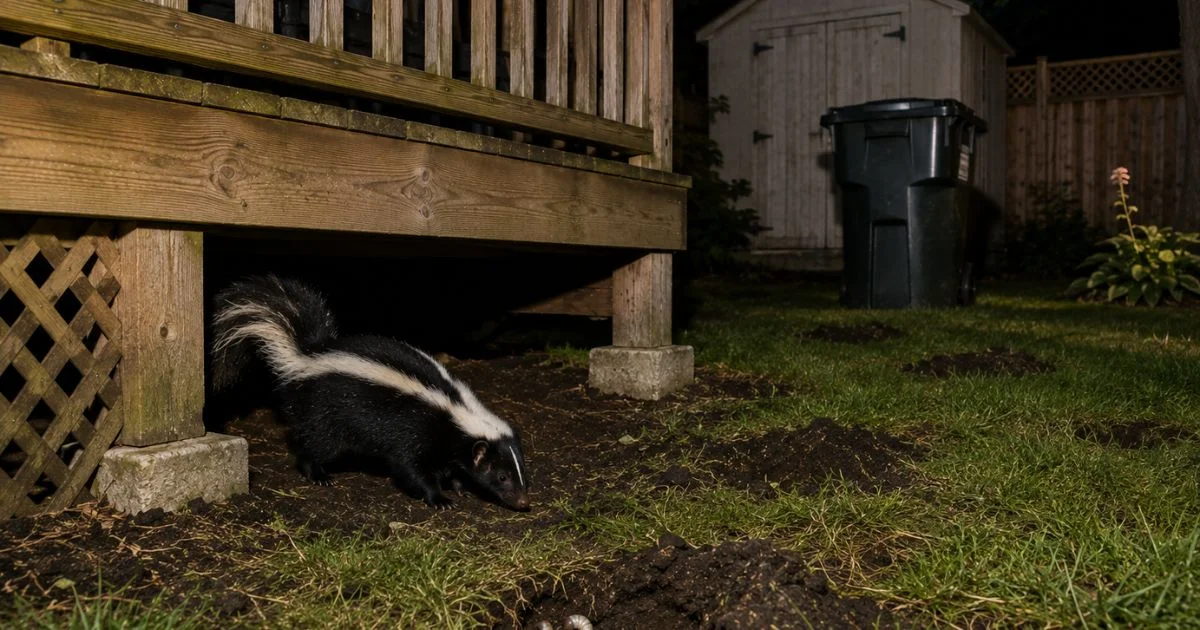
Skunks den under Etobicoke decks and porches between autumn and spring. They dig through soft soil, carry rabies vector status, and spray when cornered. A persistent musky odour, coin sized lawn holes, and scratching sounds at night are the 3 signs that confirm an occupied den beneath your property. This guide covers every stage: species identification, seasonal behaviour, health risks, legal trapping rules under the Ontario Fish and Wildlife Conservation Act, and the correct exclusion sequence to remove a skunk without a spray, a charge, or an orphaned kit trapped inside.
What a Skunk Is and Why It Ends Up in Etobicoke Backyards
The Striped Skunk, the Species You Are Dealing With in Ontario
The striped skunk, or Mephitis mephitis, is the sole Ontario wildlife species of its kind in southern Ontario. It belongs to the Mephitidae family and holds status as a furbearing mammal under the Ontario Fish and Wildlife Conservation Act. Its sturdy low body ends in a broad bushy tail, and curved digging claws make short work of soft garden soil. Two white dorsal stripes run down jet black and white colouring from head to tail. No spotted skunk shares this range.
How Skunks Behave at Night and Why You Rarely See One
The striped skunk operates on a strict dusk to dawn activity window, peaking at dusk activity peak before returning to cover by sunrise. Its nocturnal behaviour means nocturnal detection by odour is the first sign most Etobicoke residents get. Each skunk travels a solitary foraging range and rarely crosses another’s path. Before spraying, it runs a full warning sequence: foot stomping, tail raise, then hissing. Only then does the anal gland release a thiol compound, a sulphur based oil with a spray range of six metres and a spray recharge period of up to a week.
Signs of Skunk Activity on Your Property
The Odour, the Digging and the Den Entrance
A persistent low odour near a deck base, porch foundation, or shed skirting points to an occupied den. Skunks produce a musky gland secretion daily, separate from a full spray. That baseline smell differs from spray odour the spray odour versus den odour distinction matters when identifying the problem. Check for a dug soil mound with loose fill at entrance and an entry hole diameter of roughly 15 centimetres at any crawl space opening or under deck access point.
Tracks, Droppings and Sounds Under a Deck
A skunk leaves a five toed footprint with a clear visible claw impression pressed into soft soil. The front track versus rear track distinction shows the rear print slightly longer and wider. Skunk droppings contain insect chitin in scat and berry seed in scat, which separates them from rat waste. A scratching sound at night or dragging sound during the nocturnal sound window confirms activity. Deck floor vibration and a soil disturbance pattern under deck seal the identification when identifying skunk versus rat sound becomes difficult.
Skunk, Raccoon or Groundhog, Reading the Damage Correctly
A skunk lawn hole is a coin sized shallow hole, roughly 5 centimetres wide, left by one night foraging. Raccoon lawn damage looks different except rolled sod and turf peeling across a wider area. A groundhog burrow shows a large entrance mound with burrow diameter 25 to 30 centimetres and a heavy spoil mound from deep soil excavation volume. The damage pattern and nocturnal versus diurnal timing separate all three species. Skunks dig at night; groundhogs work by day. The City of Toronto raccoon information page confirms raccoon damage runs deeper and wider than skunk foraging damage versus structural damage.
Why Skunks Choose Certain Etobicoke Properties Over Others
Deck, Porch and Crawl Space Access in Mimico, New Toronto and Long Branch
A raised wood porch with an open deck skirting or unenclosed base is the most commonly denned structure type in Etobicoke. Post war bungalows along Lakeshore Etobicoke housing streets in Mimico, New Toronto, and Long Branch sit on pier and beam foundations with crawl space gaps wide enough for a skunk to enter. Alderwood semi detached homes share the same vulnerability at the foundation skirting gap. Any dark enclosed void beneath a shed with unsecured base works just as well.
Lawn Grubs and Soil Conditions in The Kingsway and Markland Wood
Chafer grubs, including the June beetle larva of Amphimallon majale, concentrate in irrigated lawns with sandy loam soil and low digging resistance. Humber River floodplain soil across The Kingsway and Markland Wood holds high lawn grub populations through late August grub availability into a strong September digging pattern. Skunks follow grub density, not habit. A coin sized lawn hole cluster across over irrigated turf confirms grub driven foraging the night before.
The Humber River Corridor and Etobicoke Creek Ravine as Entry Routes
The Humber River wildlife corridor and Etobicoke Creek ravine form a connected ravine system that moves skunks from green space into urban backyards nightly. Lambton Woods, James Gardens, and Humber Valley Village feed directly into corridor adjacent streets. Skunks follow a nightly foraging route outward from Centennial Park, Marie Curtis Park and Humber Bay Shores. Any ravine edge property near Colonel Samuel Smith Park sits on an active urban green corridor used for ravine to backyard movement.
Food Sources You Are Leaving Out Without Realising
Skunks are opportunistic feeders with a broad omnivore diet that includes almost any ground level food source. An unsecured green bin or compost bin with an unsecured lid left out during City of Toronto collection night creates a direct garbage night attractant window. Pet food left outdoors, birdseed feeder spillover and fallen fruit from garden trees all register as active food attractants. Pull every garbage bin inside after the curbside overnight exposure window closes to cut that draw.
The Etobicoke Skunk Year, Month by Month
Winter Torpor and the Lakeshore Microclimate
The striped skunk enters a torpor state each winter, but not true hibernation. Its reduced metabolic rate drops body temperature only partially, leaving it responsive to warm spells. Communal winter den groups of up to 12 animals share heat underground through the coldest months. The Lakeshore Etobicoke microclimate, shaped by the Lake Ontario temperature moderating effect, keeps Mimico winter temperature and New Toronto waterfront readings milder than inland Toronto. That warmth triggers mid winter emergence and opportunistic foraging during warm spell events as early as January.
February to May, Breeding Season and Kits Under the Deck
Mating season runs February to March, followed by an eight week gestation period. A litter size of four to seven kits arrives during the May birth window beneath occupied decks and porches. The nursing period lasts roughly eight weeks of kit weaning before young skunks forage independently. Mother skunk defensive behaviour peaks during this window, creating a heightened spray risk during nursing. The Toronto Wildlife Centre kit guidance warns against sealing any active den spring risk between May to August due to spring kit presence and potential orphaned kit entrapment.
Late Summer and Autumn, Grub Digging and Den Selection
August grub digging marks the late summer foraging peak across Etobicoke lawns. September lawn hole concentration spreads across irrigated turf as lawn grub populations near the surface. Skunks enter pre-torpor feeding through autumn, building fat reserves fast. Autumn fat accumulation drives relentless nightly foraging until temperatures fall consistently. October brings winter den scouting and new den site identification, including abandoned burrow reuse beneath sheds and decks. An Etobicoke autumn property check before October closes the window on October den selection before a skunk moves in for the season.
Health and Property Risks, Assessed Honestly
Rabies in Ontario, What the Provincial Numbers Actually Show
Rabies remains active in Ontario wildlife, with 121 confirmed cases in 2025 logged through. The bat variant accounted for 116 cases, while the Arctic fox variant contributed 5 cases. The raccoon variant recorded zero cases in 2025, marking a second consecutive year with no detections. Across 2,070 animal samples submitted in Ontario 2025 to the Canadian Food Inspection Agency, the provincial surveillance programme confirmed the skunk as an active rabies vector species. A low case count does not eliminate reporting obligation under Ontario law.
Dogs, Cats and Children, Reducing Contact Risk
An unvaccinated dog carries the highest risk from skunk contact in Etobicoke backyards. Check rabies vaccination status and booster currency for every pet before autumn. After dark leash control and pet containment at night remove the most common exposure contact pathway. Skunk spray to the eye causes eye irritation and temporary vision impairment in both pets and children. Any bite wound or scratch wound needs immediate soap and water flush, followed by veterinary assessment or immediate medical assessment. Report every exposure through Toronto Public Health rabies exposure reporting at 311 Toronto.
Fleas, Ticks and Secondary Contamination
Skunks carry ectoparasites including fleas, ticks, and mites embedded in nesting material contamination left inside dens. Contaminated soil under the deck creates a direct secondary infestation pathway into the home. Dermacentor variabilis, the dog tick, and Ixodes scapularis, the black legged tick, both transfer through flea transfer to pet contact at den entrances. Parasitic load inside an occupied den rises through the breeding season. Health Canada pest management guidance recommends full den clearing only after confirmed skunk removal to limit den clearing contamination risk.
Structural Damage from Digging Under Porches and Sheds
Soil displacement under porch foundations begins with shallow foraging but deepens with repeated seasonal use. Footing exposure and patio slab undermining follow once a den runs more than one winter beneath the same structure. Pier settlement and foundation void formation create uneven load distribution across older Etobicoke porch construction. Skunks also tear insulation in crawl spaces, expose sub floor wiring, and open wall cavity access points during den expansion. Moisture intrusion from open crawl spaces accelerates rot once the soil seal breaks. The long term structural consequence of repeated digging moves beyond pest nuisance into a real repair cost.
Preventing Skunks Before They Den
Removing Attractants from the Yard
A secured lid on every garbage bin and green bin overnight storage cuts the collection night exposure window completely. Pull pet food indoors at dusk, relocate every birdseed feeder, and clear fallen fruit before nightfall. Brush pile removal and overgrown hedge clearance eliminate resting cover near the home. The City of Toronto waste storage rule requires bins stored on private property until collection morning. Ground level food source elimination removes the primary reason skunks enter residential yards.
Sealing Structural Access with Buried Screening
Galvanised steel mesh at the correct hardware cloth gauge buried to a depth of 20 to 30 centimetres with an outward L shaped flare stops digging at any deck skirt installation or shed base exclusion point. Always place a one way door first and follow the full exclusion sequence before permanent sealing. The verification period before permanent seal confirms no animal remains inside. Never seal during kit safe exclusion timing windows between May and August. Post war porch exclusion in Mimico and Long Branch requires custom fitting around irregular crawl space vent covers.
Lawn and Landscaping Choices That Reduce Grub Load
Beneficial nematode treatment using Heterorhabditis bacteriophora or Steinernema carpocapsae targets chafer grubs below the surface. Match nematode application timing to soil temperature above 12 degrees Celsius for full chafer grub biological control. Shift to a reduced turf irrigation schedule and drought tolerant grass cultivar to raise grub threshold level and lower skunk interest. All products must carry Health Canada PMRA registered status. Check the pesticide label compliance requirements before any lawn treatment in Etobicoke.
A Seasonal Inspection Routine for Etobicoke Homeowners
Run a post winter inspection each March and a pre-winter inspection each October as the core Etobicoke housing inspection schedule. Check every deck base, shed base, crawl space vent, and fence gap during each perimeter inspection. Early detection before occupation costs nothing. A skunk already denning costs hundreds. Complete any structural gap repair before the denning season opens in late autumn. The property owner maintenance obligation under Toronto municipal code places full responsibility for exclusion sequence completion on the homeowner.
What Toronto and Ontario Rules Allow You to Do
The One Kilometre and 24 Hour Release Rule
Ontario sets a strict 24 hour release window for any captured wildlife on private property. The one kilometre release radius means the animal returns to the same property release point or an adjacent lot with adjacent property permission. Relocation prohibition beyond one kilometre applies to all homeowners without exception. Toronto Animal Services guidance confirms this Ontario release requirement under the City of Toronto trapping conditions. Breaking the captured wildlife release obligation carries a direct charge under the humane live trap release protocol.
Skunk Dens and MNRF Den Destruction Approval
The striped skunk qualifies as a furbearing mammal under Ontario law, but carries a clear skunk den exemption from the standard MNRF den destruction approval requirement. Den destruction without approval is permitted for skunks, unlike fox dens which fall under full fur bearing mammal den protection. The City of Toronto trapping page confirms this exemption directly. Always verify the current Ontario furbearing mammal definition before taking any den action.
Traps, Poison and What Brings Charges in Toronto
Body gripping trap prohibition covers all spring loaded devices on residential Etobicoke properties. Poison prohibition extends to any rodenticide misuse targeting wildlife, carrying both a provincial charge and potential criminal charge. Firearm discharge within city limits violates the Firearms Act Toronto prohibition outright. Toronto Animal Services does not supply traps and operates outside the role of a Toronto Animal Services licensed trapper. Full enforcement runs through the Ontario Fish and Wildlife Conservation Act enforcement division. Review City of Toronto wildlife trapping guidance before touching any device.
Reporting a Bite or Scratch to Toronto Public Health
Any bite wound, scratch wound, or saliva contact from a skunk triggers a reportable wildlife exposure under Ontario Public Health Standards. File a 311 Toronto service request within hours of contact, not days. A physician completes a rabies post exposure prophylaxis assessment and PEP eligibility evaluation during medical assessment within 24 hours. Pets follow the same timeline through veterinary assessment for pets. The Toronto Public Health contact pathway and Ontario rabies exposure protocol both require documentation of the incident location and animal description.
Removal Options and the Point Where a Licensed Technician Makes Sense
One Way Doors and Exclusion, How the Method Works
A one way door mechanism fits directly over the den face and functions as an exit only device that blocks re-entry prevention once the skunk leaves. The exclusion sequence requires a verification period after installation before any permanent seal goes in. Run a physical kit check before sealing to confirm no young remain inside. Toronto Wildlife Centre exclusion guidance warns that an occupied den during spring creates serious injury risk during removal. A humane cage trap placed inside the one way door system works as an alternative when the den vacancy confirmation step proves difficult.
What Drives the Cost of Professional Skunk Removal
No fixed price covers skunk removal in Etobicoke. Den access difficulty and deck skirting removal requirement add labour time before exclusion even starts. Kit presence triggers a kit presence surcharge due to extended monitoring requirements. Post spray decontamination scope adds cost when a skunk discharges inside a confined space. Structural repair cost and exclusion repair scope vary by the condition of the den count per property. Every quote reflects removal cost factors specific to that property, not a standard rate. A seasonal timing premium applies during peak spring and autumn periods.
Is a Skunk Denning Under Your Deck or Porch?
If you have found a den beneath your deck, porch, or shed, confirm the animal has left and check for young before sealing any entry point. Pestiseed can help you explore professional skunk removal and exclusion options in Etobicoke and the GTA.
When to Handle It Yourself and When to Stop
Self managed exclusion works when 3 conditions exist: a confirmed unoccupied den, a clear single access point, and no kit presence confirmed. Stop immediately when the calendar enters the May to August stop period. A repeat return after sealing signals a second entry point the homeowner missed. Close range spray risk at a confined den escalates fast without proper equipment. At that point, escalation to a licensed technician is the only reasonable step. Ontario sets a wildlife handling licence requirement for trapping and relocation. Toronto Wildlife Centre hiring guidance lists what credentials a legitimate operator carries before any work begins.
FAQs
How do I know if a skunk is living under my deck?
A persistent musky odor under deck, loose soil at the den entrance, coin sized lawn holes, and a scratching sound at night confirm an occupied den. The occupied den odour stays constant. A passing spray fades within hours.
Are skunks in Etobicoke dangerous to my dog?
An unvaccinated dog carries real rabies risk from a single Etobicoke encounter. Check rabies vaccination booster currency. Apply the after dark leash rule. Spray to dog’s eyes causes irritation. Book dog veterinary assessment after spray immediately.
Can I trap a skunk myself in Toronto?
Self trapping is legal in Toronto using a humane live trap. The City of Toronto release obligation requires 24 hour release within a one kilometre release radius. Toronto Animal Services provides no traps. Prohibited devices carry a provincial charge under the Fish and Wildlife Conservation Act.
When are baby skunks born in Ontario?
The Ontario kit birth window runs through May. February to March mating leads to an eight week gestation. Litter size reaches four to seven kits. The nursing period lasts eight weeks. Never seal a den between May to August.
How long does a skunk stay under a deck?
A skunk follows an autumn to spring occupation window in a single season. Without exclusion as a permanent solution, multi year return to the same site is common. Maternal den reuse increases each year. Attractant removal lowers but does not eliminate return probability.
What do I do if my dog gets sprayed?
Keep the dog outdoors. Flush eyes with water immediately. Apply a hydrogen peroxide, baking soda, and dish soap solution. Skip tomato juice. Check for any bite wound. Contact a vet. File a Toronto Public Health bite report if skin broke.
Skunks Living Beneath Your Deck?
Get Help With Professional Removal and Exclusion
An active skunk den can be difficult to manage when access is limited or young may be present. Contact Pestiseed to discuss skunk removal and exclusion options for your Etobicoke or GTA property.