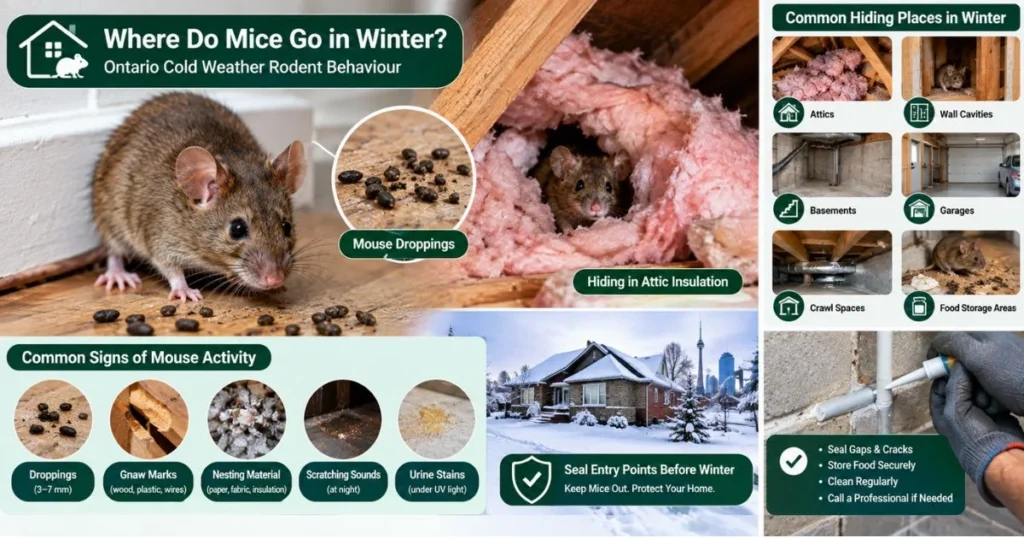
Ontario homeowners find 3 mouse species indoors and most misidentify which one they have. A house mouse and a deer mouse need completely different treatment approaches. Misidentifying the species delays control by weeks and leaves hantavirus risk unaddressed in attics and crawl spaces. This guide gives Ontario homeowners the exact visual markers, nesting signs and health risks tied to each species.
Two Common Mouse Species in Ontario
The House Mouse An Introduced Urban Species
Mus musculus produces up to 12 litters per year inside heated buildings, making it Ontario’s fastest breeding indoor mouse. That rapid breeding explains why a small infestation can become a large one within a few months. Pest professionals classify the house mouse as a commensal species because it relies almost entirely on human food and shelter. Health Canada associates house mice with salmonellosis and leptospirosis rather than hantavirus.
The Deer Mouse and the White Footed Mouse
In Ontario’s GTA greenbelt edge zones, Peromyscus maniculatus and Peromyscus leucopus both appear near homes. Both native species carry hantavirus. Peromyscus leucopus also carries Borrelia burgdorferi, the bacteria behind Lyme disease. White footed mice and deer mice look similar at first glance, but their differences become obvious once you compare their eyes, body size, and habitat. White footed mice usually have larger, more prominent eyes, while deer mice tend to have a slightly larger body.
How to Identify Each Species Mice
Fur Colour, Tail and Body Size
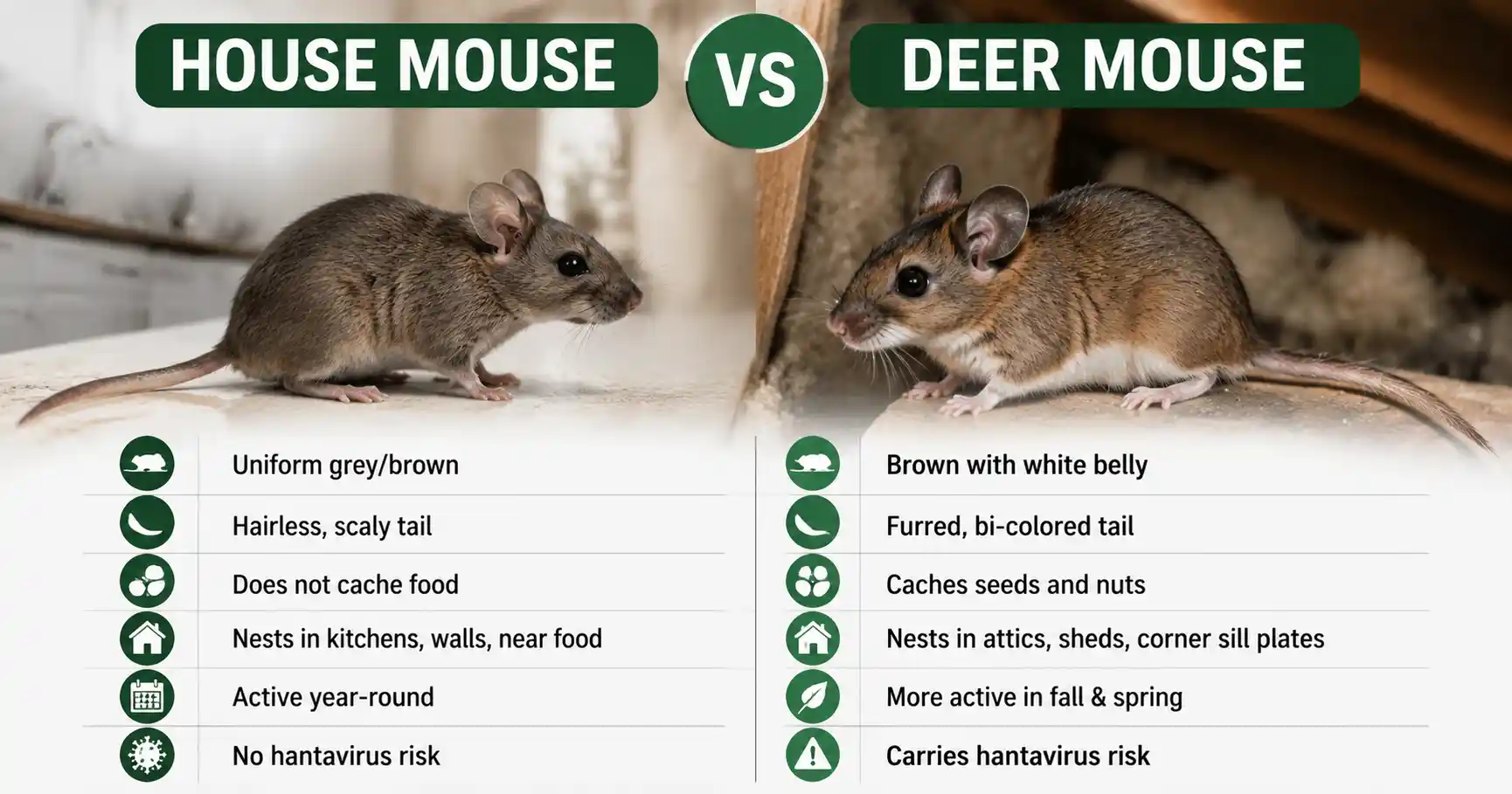
The deer mouse tail carries fine fur and runs bicoloured darker on top, white underneath. The house mouse tail is hairless, scaly and single toned Orkin Canada notes it nearly doubles body length. Deer mouse hind legs run noticeably longer than front legs, a feature PCT Online flags as a reliable field marker. White feet and a white belly confirm a deer mouse uniform buff grey across the entire body confirms a house mouse.
Droppings and Nesting Signs
Find a seed cache in a wall void or dresser drawer that points to a deer mouse, not a house mouse. Deer mice store food near their nest house mice eat near the source and never cache. PCT Online confirms deer mouse nests exceed 1 foot in diameter and get abandoned when fouled creating a nest migration trail of multiple nests in one zone. Dry deer mouse nests become dangerous when they are disturbed. Moving insulation or sweeping dried droppings can release virus particles into the air, increasing the risk of inhalation.
Found Mouse Droppings or Nesting Signs in Your Home?
Not sure whether you’re dealing with house mice or deer mice? Pestiseed can inspect nesting areas, identify signs of mouse activity and recommend the right control approach without unnecessary disturbance of contaminated materials.
Licensed & Insured
Toronto & GTA
Professional Pest Control
Why Deer Mice Enter Ontario Homes
House Mouse Nesting
In Toronto kitchen zones, house mice build nests behind appliances, under sinks and inside wall voids near food prep areas. Orkin Canada confirms house mice eat up to 30 meals per 24 hour period always within their thermal nesting corridor between a heat source and a food source. Gnawing through electrical wiring, drywall and plastic pipes creates fire risk inside Ontario homes. Grease trails along baseboards often reveal the route mice use every night. Following those marks can help homeowners locate the nesting area faster than searching randomly.
Deer Mouse Nesting Attics, Crawl Spaces, and Corner Sill Plates
Once a tree branch contacts a roofline, deer mice gain direct attic access within one season. PCT Online confirms Peromyscus maniculatus climbs trees, shrubs and vines to reach upper structure entry points. Inside Ontario homes, deer mice target corner sill plates, the pressure treated wood sitting on the foundation edge as a primary nesting cavity. Disturbing dry abandoned nests in these zones releases hantavirus particles into the air through aerosolisation.
House Mouse vs Deer Mouse Ontario
| Feature | House Mouse | Deer Mouse |
| Belly | Grey | White |
| Tail | Hairless | Furred |
| Hantavirus | No | Yes |
| Food Cache | No | Yes |
| Nest | Kitchen | Attic |
| Active | Year round | Autumn |
| Lyme Disease | No | Possible association via ticks |
What the Deer Mouse Means for Ontario Homeowners
Hantavirus Pulmonary Syndrome and Deer Mice
Symptoms hit 1 to 5 weeks after exposure starting with fever, then progressing to breathing failure. Public Health Ontario tracks hantavirus as a reportable disease under the Health Protection and Promotion Act. Breathing in dried deer mouse urine or droppings is the only confirmed transmission route no human to human spread exists. Homeowners cleaning attics near the Rouge or Humber corridors face the highest HPS exposure risk in the GTA.
What Diseases House Mice Carry in Ontario Homes
3 confirmed diseases travel with Mus musculus indoors salmonellosis, leptospirosis, and LCMV. Lymphocytic choriomeningitis virus hits pregnant women and immunocompromised people hardest Health Canada documents this risk directly. Mouse urine on a kitchen counter spreads salmonellosis before any visible sign appears. Fleas and mites from house mice produce dermatitis, a skin reaction Orkin Canada ties to active infestations.
Safe Cleanup of Mouse Droppings
Open every window. Wait 30 minutes before touching anything Health Canada requires this ventilation step first. Wet the droppings with a 1 to 10 bleach solution and let it soak before wiping, never sweep or vacuum dry droppings. Wear an N95 respirator and rubber gloves through the entire process without exception. Double bag all waste, tie it shut and drop it in a covered outdoor bin before removing your gloves.
| Feature | House Mouse | Deer Mouse |
| Eyes | Smaller | Larger |
| Entry Point | Wall gaps, kitchens | Rooflines, attics |
Which Mouse Do Ontario Homeowners Most Commonly Find Indoors?
Urban Toronto and Etobicoke Almost Always the House Mouse
In downtown Toronto and North York, the urban food density driver sustains house mouse populations every month of the year. Restaurants, food retail and residential food waste create a permanent food supply no wildlife corridor needed. Multi-unit buildings in Etobicoke and Mississauga see Mus musculus transit between units through shared wall voids and pipe chases. Northern Etobicoke near the Humber valley corridor sees occasional deer mouse pressure each autumn, the one urban exception.
Suburban Fringe and Rural Edge Properties
2 entry windows define the deer mouse intrusion pattern at fringe properties September through November and again March through April. Detached homes in Pickering, Aurora, Caledon and King Township backing onto ravines or woodlots carry the highest fringe property mouse risk profile in the GTA. Deer mice overwinter first in garages and sheds, then migrate into the main structure when outbuilding temperatures drop below tolerance. Rural York Region properties near the Ontario Greenbelt edge face deer mouse pressure in outbuildings year round.
I highly recommend Pestiseed Pest Control for homeowners dealing with house mice or deer mice in Toronto and the GTA. Their team provides professional mice control in Etobicoke, inspects attics, kitchens, crawl spaces. Other nesting areas and helps identify entry points to prevent future infestations. If you notice mouse droppings, scratching noises, or nesting signs in your home. Pestiseed is a great option for professional mice control and long term prevention.
FAQs
What does a deer mouse look like compared to a house mouse?
Deer mice show a white belly, white feet, large eyes and a bicoloured furred tail. House mice run uniformly grey brown with a hairless single tone tail and small pinkish feet. Deer mice measure slightly larger at 3 to 4 inches.
Is hantavirus a real risk for Ontario homeowners near Toronto?
Hantavirus is rare but documented in Ontario, confirmed by Public Health Ontario surveillance. Properties near the Rouge, Don Valley and Humber corridors carry higher risk. Correct cleanup protocols reduce exposure risk to near zero.
How do I know if I have a house mouse or deer mouse in my attic?
Find a seed cache near a corner sill plate, a bicoloured furred tail, or a nest migration trail all confirm a deer mouse. A single nest near insulation with no food cache points to a house mouse.
Book Now to Identify House Mouse vs Deer Mouse
Pestiseed Pest Control technicians identify house mouse and deer mouse activity across Ontario properties in one inspection visit. Wrong species identification delays treatment by weeks. Book your rodent inspection with Pestiseed today.
Not Sure Which Mouse Is Living in Your Home?
Let Pestiseed Identify the Activity and Recommend the Right Treatment.
Pestiseed can inspect your attic, kitchen, crawl space and other suspected nesting areas to assess mouse activity, identify possible entry points and recommend appropriate mice control measures across Toronto, Etobicoke and the GTA.
Licensed & Insured
Toronto & GTA
Pest & Wildlife Control