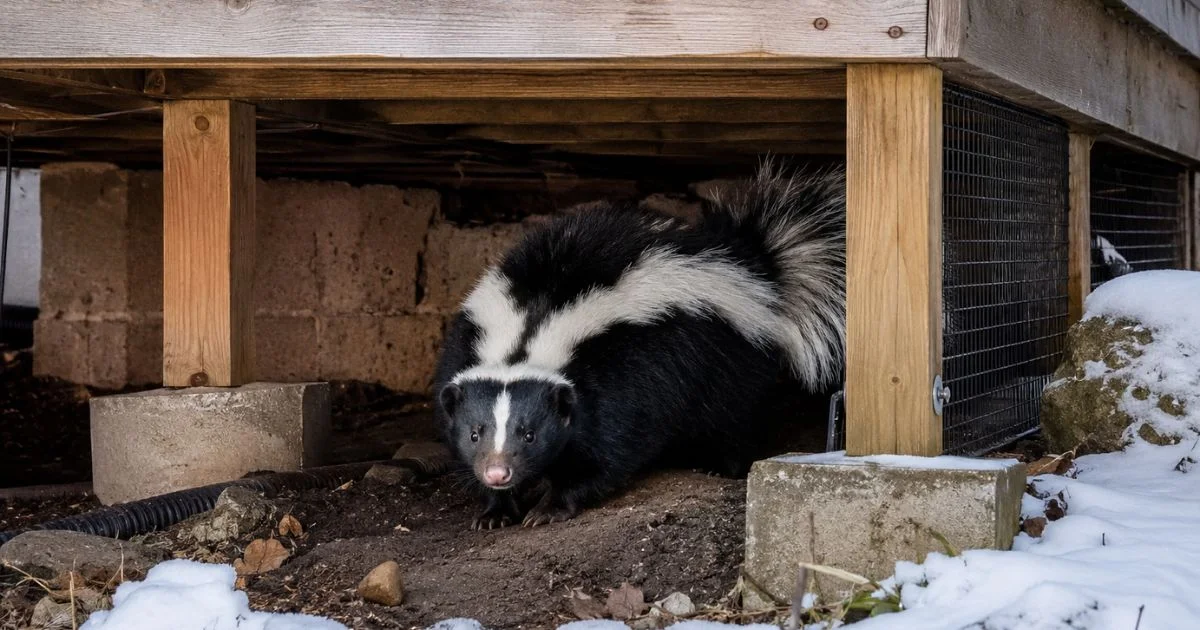
Skunks do not leave Etobicoke properties in winter. A skunk enters torpor under your deck and stays through March. Freeze thaw cycles trigger repeated nocturnal emergence, meaning the animal moves, forages, and returns. Thiol compound odour, five toed prints in snow, and low frequency movement noise confirm an active den below. Sealing the entrance without an occupancy check causes entrapment under Ontario law. Run a two mild night observation window test first. Then apply humane exclusion with a one way door after empty den confirmation. Deck perimeter screening and autumn preparation before October stop a second winter occupancy permanently.
Skunks Do Not Hibernate, They Enter Torpor
What torpor means for a skunk under your property
A skunk enters torpor, not true hibernation. Controlled metabolic suppression drops the skunk’s resting metabolic rate without full shutdown. Den occupancy continues through winter inside a crawl space, raised deck cavity, or shed underside. Continuous occupancy through winter means the animal never fully leaves.
Why a winter skunk is still awake at intervals
Each arousal window breaks the torpor when temperatures shift. An above freezing night in Etobicoke triggers nocturnal emergence for water access. The freeze thaw cycle creates repeated den exit and re entry events. Etobicoke homeowners report winter sightings even in January.
What Happens Inside a Skunk During Winter
Body temperature and metabolism through the cold months
Skunks practice heterothermy, not full hibernation. Body temperature drops from 37.7 degrees Celsius in July to 28.4 degrees Celsius in January. Euthermia returns during each arousal period. The 7.2 degree January diel range keeps metabolism running at basal metabolic level.
Fat reserves and the winter energy deficit
An adult male skunk enters winter carrying 32 percent body fat by October. Prolonged fasting burns reserves down to 10 percent body fat by late April. Fat depletion rate creates a 44 percent energy deficit across winter. Spring weight loss confirms the stored energy limit was nearly reached.
What wakes a skunk from torpor
Ambient temperature rise above freezing is the primary arousal trigger. Snowmelt and thaw signal food availability near the den. In Etobicoke Skunk den microclimate shifts faster under decks than open ground. Hunger driven emergence follows, and surface activity resumes before spring officially arrives.
Torpor and Hibernation Compared
Depth and duration of dormancy
Skunks hold the lowest recorded body temperature for a carnivore at 26.0 degrees Celsius. Each torpor bout lasts 7.8 hours solitary versus 5.4 hours grouped. True bears complete a multi week hibernation bout without waking. Skunks cycle in hours not months across a 120 day study period.
Feeding and movement during dormancy
Intermittent foraging separates skunks from true hibernators completely. Between feeding drives den departure even during Etobicoke winters. Snow surface travel leaves a visible scent trail and winter track sighting near porches. Short range movement always ends with a return to den before dawn.
Winter Skunk Behaviour in Etobicoke
Lake Ontario moderation keeps Etobicoke warmer than inland Ontario zones. Toronto Pearson climate normals from Environment and Climate Change Canada confirm frequent above freezing stretch events across the December to March window. Freeze thaw frequency in the Greater Toronto Area drives more nocturnal movement than colder regions see.
Humber Bay Shores residents report winter activity pattern sightings near waterfront green corridors. Snow cover period in Etobicoke rarely stays unbroken for weeks. The City of Toronto climate report links mild spells to increased urban wildlife den exits. Nocturnal movement peaks within 48 hours after each thaw across Toronto, Ontario.
Where Skunks Build Winter Dens in Etobicoke Neighbourhoods
Decks, sheds, porches and crawl spaces in Mimico and Alderwood
A raised wooden deck in Mimico gives skunks direct ground level access points through unsealed skirting. Deck joist space traps heat above exposed soil at deck base. Alderwood detached shed foundations and open crawl space openings get used heavily. Skunks burrow beneath structure through any gap near a foundation wall or basement vent.
Why soil, warmth and wind exposure decide the den site
Loose soil and sandy loam make excavation faster than clay content ground. Radiant heat from foundation walls raises den temperature several degrees above outside air. Wind block from a front porch or fence reduces heat loss overnight. Skunks weigh insulation value, soil drainage, and food proximity before committing to any site.
When several skunks share one winter den
Female group denning produces a communal den with up to 12 skunks sharing space. Social thermoregulation through huddling cuts torpor bouts from 50 torpor bouts in 120 days solitary down to just 6 torpor bouts in 120 days grouped. Spring body fat measures 25.5 percent grouped versus 9.3 percent spring body fat solitary. Grouped skunks survive winter with significantly more stored energy remaining.
Signs a Winter Den Under Your Deck Is Still Active
Tracks, fresh digging and snow disturbance
A five toed print with visible claw mark confirms skunk presence after fresh snowfall test. Front paw track and hind paw track appear in a staggered trail pattern leading directly to one opening. Reopened excavation shows soil spray at entrance pushed outward from inside. Single entrance use and occasional drag marks nearby confirm active den occupancy.
Odour during thaws and sounds under the floor
Skunk musk contains thiol compound that releases stronger during warm air odour release events. A faint persistent smell entering through a floor vent or rising into a basement signals an active den below. Low frequency movement noise heard at night confirms arousal activity. Dog alerting behaviour near deck edges is one of the earliest detection signals Etobicoke homeowners notice.
How to check an entry hole without disturbing the den
Pack a loose fill test using a crumpled newspaper plug or straw plug across the entry point. Check disturbance across a two mild night observation window before drawing conclusions. Entrance monitoring with a camera check gives clear evidence without contact. Never use no probing, no flooding, or no smoke test methods inside any active crawl space den.
Skunk Winter Timeline From October to May
Activity decline begins in September across the southern Ontario calendar as temperatures drop. Month by month behaviour shifts toward full denning season entry by mid December. Near zero surface activity is held from December to early April in Etobicoke. The seasonal cycle moves predictably each year without exception.
Activity resumption starts in March with scattered nocturnal emergence during thaw events. A sharp April increase follows as the breeding cycle begins and food sources return. The emergence period peaks before May across Etobicoke neighbourhoods. This timeline table pattern repeats annually regardless of individual winter severity.
Waiting, Sealing or Removing a Winter Skunk in Toronto
Winter eviction during active torpor causes stress and raises spray risk significantly. The Ontario Fish and Wildlife Conservation Act restricts relocation beyond the 1 kilometre relocation limit from the capture point. Humane exclusion using a one way door remains the safest legal method in Toronto, Ontario. Toronto Wildlife Centre and Toronto Animal Services both provide guidance on private property responsibility.
Entrance sealing works only after confirmed den vacancy through monitoring decision steps. A live trap requires daily checking under Ontario law without exception. Light and noise deterrent methods act as a harassment technique to encourage voluntary den departure. Etobicoke homeowners should wait until the emergence period before applying any permanent entrance sealing solution.
Think a Skunk Is Wintering Under Your Deck?
Before sealing an entry point, make sure the den is empty. Pestiseed can help with skunk removal and humane exclusion for properties in Etobicoke and the surrounding GTA.
Licensed & Insured
Toronto & GTA
Pest & Wildlife Control
What to Do Next If a Skunk Is Denning Under Your Property
Confirming occupancy before any structural work
Run a full occupancy check before scheduling any contractor in Etobicoke. The entrance observation period requires at least 2 mild nights of night observation near the opening. Verification step comes before sealing this is the non negotiable sequencing rule. Only empty den confirmation justifies moving forward with structural work.
Preventing a second winter under the same deck
Deck perimeter screening with exterior grade fastener and washer fastening blocks future ground level access. Shed base sealing and porch skirting repair close the 2 most common re-entry points in Etobicoke yards. Autumn preparation before October removes the opportunity before skunks begin seeking dens. Garbage bin lid security, fallen fruit removal, and dead leaf clearing cut food incentives near the structure. Install a motion sensor light along the deck perimeter as a final deterrent layer.
FAQs
Do skunks come out of their dens in winter in Ontario?
Yes. Skunks have no full hibernation. Every above freezing night triggers brief den exit and night time foraging. Snow tracks confirm winter emergence during any mild spell activity across Ontario.
Why do I smell skunk in January?
January odour comes from thaw released musk or a defensive spray from a startled skunk. Mating season scent marking also raises odour intensity change near any foundation during mild spells.
Can a skunk survive all winter under my deck?
Yes. A sheltered cavity provides enough warmth. Stored fat sufficiency and supplemental foraging during thaws support full winter survival through March. Single season occupancy under one deck is common in Etobicoke.
Do skunks have babies during winter in Ontario?
No winter births occur in Ontario. February mating begins inside the den. A pregnant female carries through the gestation period and delivers May kits. Expect den reuse for birthing come spring.
Is it safe to block a skunk hole in the winter?
No. Winter sealing risk includes entrapment when occupancy is unknown. The coldest month exclusion warning applies December through March. Follow the confirmation first rule before any safe sealing timing decision.
Is a Skunk Denning Under Your Property?
Let Pestiseed Help You Plan the Next Step
Avoid sealing an entry point until you know the den is empty. Contact Pestiseed for help with skunk removal, humane exclusion, and preventing re-entry in Etobicoke, Toronto, and surrounding GTA areas.
Licensed & Insured
Toronto & GTA
Pest & Wildlife Control