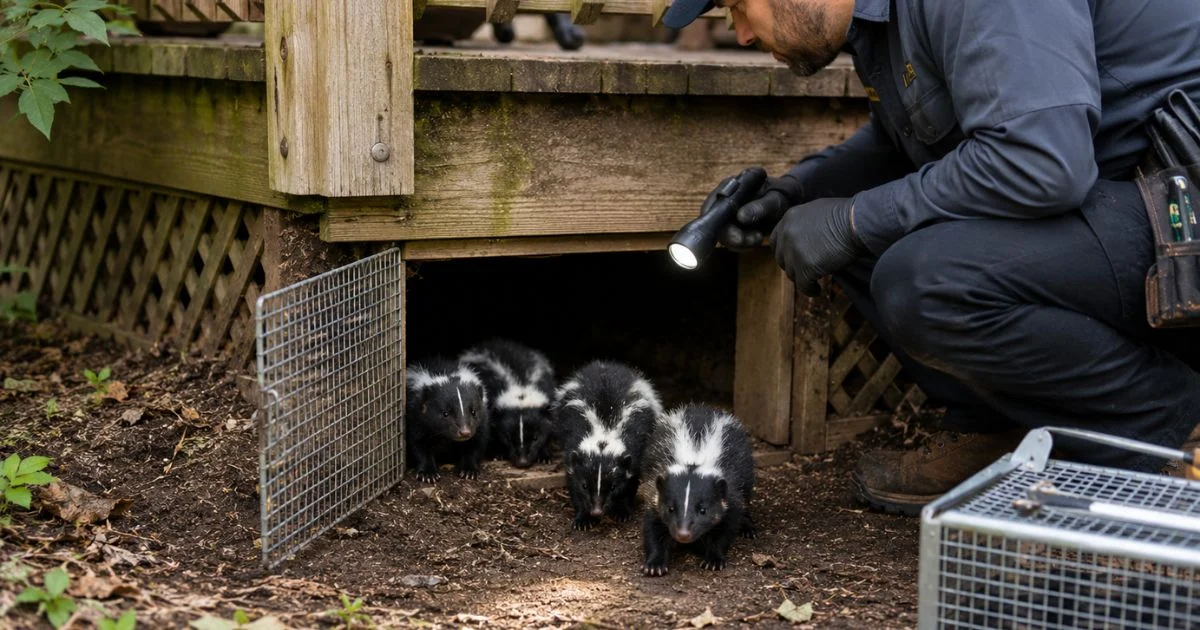
Baby skunks appear under Etobicoke decks every April and May. Most homeowners spot a skunk kit alone in the yard and either seal the entry point or call the wrong service. Both moves make things worse. Sealing den entrance prematurely traps kits inside and causes decomposition inside the wall cavity within days. The Fish and Wildlife Conservation Act 1997 prohibits handling without a Wildlife Custodian Authorization a 48 hour legal limit applies from first contact. A licensed wildlife technician uses a maternal reunion protocol first, then installs a one way exclusion door after the skunk family group exits safely.
What Baby Skunks Look Like and When They Appear in Etobicoke
Physical Features That Identify Skunk Kits at Different Ages
Skunk kit physical development follows a clear, staged timeline. Neonatal to juvenile staging moves fast the two week fur milestone brings denser coat growth. Body size progression separates a neonatal kit from a juvenile skunk quickly. Poor eyesight in skunks and no depth perception remain until 4 weeks.
When Skunk Kits Are Born and How Long They Stay in the Den
Ontario skunk breeding calendar places late winter mating in February. The April birth window and May birth window follow a six week nursing period. Kits reach eight weeks after departure after supplemental solid food begins around week 5. The skunk family group stays at the maternal den site until fall dispersal. Each kit then becomes an independent juvenile skunk.
Common Den Locations on Etobicoke Properties
Skunks Choose Decks, Porches and Shed Foundations
Sheltered cavity preference and predator exclusion behaviour make decks the top skunk den site. Grass and leaf nesting material fills the cavity fast. Matters to an omnivore foraging range of 2 miles covers most Etobicoke suburban yards.
Signs of an Active Skunk Den Versus an Abandoned One
Active den indicators include scratching sounds from below during a nocturnal movement pattern. A musky odour near the structure and skunk footprint at den entrance confirm recent use. Disturbed soil at the entry point and a visible foraging trail near den appear within 48 hours. Abandoned den indicators show no odour present, no nocturnal activity over multiple nights, and an entry hole with no recent soil disturbance after fall dispersal.
How to Tell If Baby Skunks Are Truly Orphaned
Baby Skunk Alone Does Not Always Mean the Mother Is Gone
Poor eyesight in skunks causes skunk kit group separation during a rapid scatter response. A mother frightened from young returns once the threat clears. Human intervention risk during maternal absence is real premature handling that breaks the mother rejoining the young cycle entirely.
Behavioral and Physical Signs That Kits Need Immediate Help
Crying and wandering continuously past sunrise signals genuine distress. Visible shivering and body temperature drop confirm the kit lost maternal warmth. A kit alone past dawn, showing failure to move away from human contact, needs help now. Emaciated appearance, bleeding visible, or a broken limb all require an immediate wildlife rehabilitator referral within hours.
Are Baby Skunks Dangerous to Your Family and Pets
How Baby Skunks Warn Before They Spray
Stamping front feet is always the first warning signal. The kit then shifts into arching into a U shape, looking over shoulder at threat directly. A tail raised as warning and hissing vocalization follow within seconds. Startling as a spray trigger is the biggest risk, slow movement as avoidance and speaking softly as de-escalation reduce spray incidents significantly.
Disease Risks and What Ontario Health Authorities Say
Rabies in skunks sits inside the bat skunk fox rabies triangle confirmed by Public Health Ontario. Any skunk bite wound triggers the PEP protocol Ontario rabies post exposure prophylaxis starts within 24 hours. Canine distemper in skunks and leptospirosis risk affect unvaccinated pets directly. Flea and parasite transfer from skunk to pets spreads through a single.
What Ontario Law Says About Baby Skunk Removal
The Fish and Wildlife Conservation Act and What It Prohibits
Unlawful possession of wildlife triggers a provincial offence under Ontario law. An MNRF enforcement officer handles all skunk related violations across Etobicoke. Permit exemption criteria are narrow and most homeowners don’t qualify. Wildlife defined under FWCA includes every skunk as wildlife under FWCA, regardless of age or condition.
Why Keeping a Wild Skunk at Home Is Illegal in Ontario
The 48 hour possession limit applies even to injured kits found in your yard. Beyond that, a Wildlife Custodian Authorization requirement kicks in immediately. Captivity creates human imprinting risk in kits, making releasability compromised by captivity permanent. Species specific formula requirement and species specific housing requirement exceed home care capacity the Toronto Wildlife Centre remains the only licensed authority for skunk rehabilitation in the region.
Why DIY Baby Skunk Removal Usually Makes Things Worse
Most Common Mistakes Etobicoke Homeowners Make
Feeding baby skunks with wrong food causing digestive harm delays proper rehabilitation. Moving kits without mother assessment breaks the family unit permanently. Using fast movements near skunks and frightening mothers from young trigger defensive spray instantly. Calling pest control instead of Skunk removal wastes critical hours delayed contact with rehabilitator reduces kit survival rates sharply.
Found Baby Skunks Under Your Deck or Shed?
Avoid moving the kits or sealing the den before the family has been assessed. Pestiseed can help you explore appropriate skunk removal and exclusion options in Etobicoke, Toronto, and the GTA.
Licensed & Insured
Toronto & GTA
Pest & Wildlife Control
What Happens When Entry Points Are Sealed Before Kits Are Removed
Premature entry point sealing creates 3 compounding problems inside the structure. A kit trapped inside a structure produces odour from dead animals in structure within days. Exclusion timing error and exclusion before family unit removal void any warranty on sealing work. A one way door exclusion device installed after professional inspection remains the only safe entry hole patching protocol for Etobicoke properties.
How Licensed Wildlife Technicians Remove Baby Skunks Humanely
Inspection and Den Assessment Process
Den location identification and entry point mapping happen during the first site visit. Nocturnal activity monitoring confirms the skunk family group is still present. A full property perimeter check catches secondary entry points missed visually. The inspection report documents every gap before the maternal reunion protocol begins.
Reuniting Baby Skunks with the Mother Before Exclusion Begins
A heated cozy box placed near the den triggers mother retrieval behaviour within hours. Visible placement of cozy box for mother uses the mother kit scent bond as the draw. Technicians allow a full monitoring period after cozy box placement before confirming reunification success. Handles appropriate cases involving injured, orphaned or otherwise vulnerable wildlife.
Exclusion Work and Entry Point Sealing After Removal
Hardware cloth exclusion barrier and galvanized steel mesh seal every confirmed gap. L footer barrier installation stops re-digging along shed foundation exclusion zones. Every job ends with a follow up inspection after exclusion and a written warranty on exclusion work.
How to Prevent Skunks from Denning on Your Property Next Season
Deck and Foundation Barriers That Work
L footer galvanized mesh bends 20–30 cm down and 20–30 cm outward at 90 underground to stop digging. Deck skirting reinforcement and porch lattice reinforcement close the most common Etobicoke entry points. Concrete footer installation along shed foundation gap sealing zones adds a permanent second layer.
Attractant Removal and Property Maintenance in Etobicoke
Japanese beetle larva and lawn grub population pull skunks onto treated grass nightly. Grub treatment timing in late August cuts the food source before fall denning begins. Fallen fruit cleanup schedule, compost bin with locking lid, and garbage bin wildlife proof lid remove 3 major attractants simultaneously. A spring property audit for wildlife attractants checking wood pile as harborage site and overgrown vegetation near foundation prevents next season’s den before it starts.
FAQs
Can I move baby skunks myself in Ontario?
The FWCA possession restriction allows only a 48 hour legal limit without a Wildlife Custodian Authorization. Unlicensed handling risks spray, bite and orphaning. A licensed wildlife technician avoids an Ontario provincial offence.
How long before baby skunks leave the den on their own?
Baby skunks reach the eight week den departure milestone after weaning at six weeks. Fall dispersal happens by September. Each independent juvenile skunk leaves the maternal den site during September dispersal in Ontario.
Will the mother skunk return if I go near the den?
Mother abandonment is rare. Maternal return behaviour depends on slow movement protocol and monitoring from distance. Human scent near the den delays the night return window but doesn’t stop it. Fast movements frighten mother permanently.
What do I do if my dog has been sprayed near a baby skunk den?
Apply a 1 quart hydrogen peroxide formula with quarter cup baking soda and dishwashing detergent. Contact a veterinarian after the dog spray incident. Call Toronto Public Health if a bite wound needs rabies exposure assessment.
Who do I call for baby skunk removal in Etobicoke?
For baby skunk removal in Etobicoke, contact Pestiseed Incorporated for 24/7 emergency wildlife removal. If the situation involves an injured or orphaned baby skunk, a licensed wildlife rehabilitator may also be appropriate.
Need Help With Baby Skunks?
Let Pestiseed Help You Plan the Next Step
If baby skunks are under your deck or shed, get guidance on the next steps before disturbing the den or blocking its entrance. Contact Pestiseed about skunk removal in Etobicoke, Toronto, and surrounding GTA areas.
Licensed & Insured
Toronto & GTA
Pest & Wildlife Control