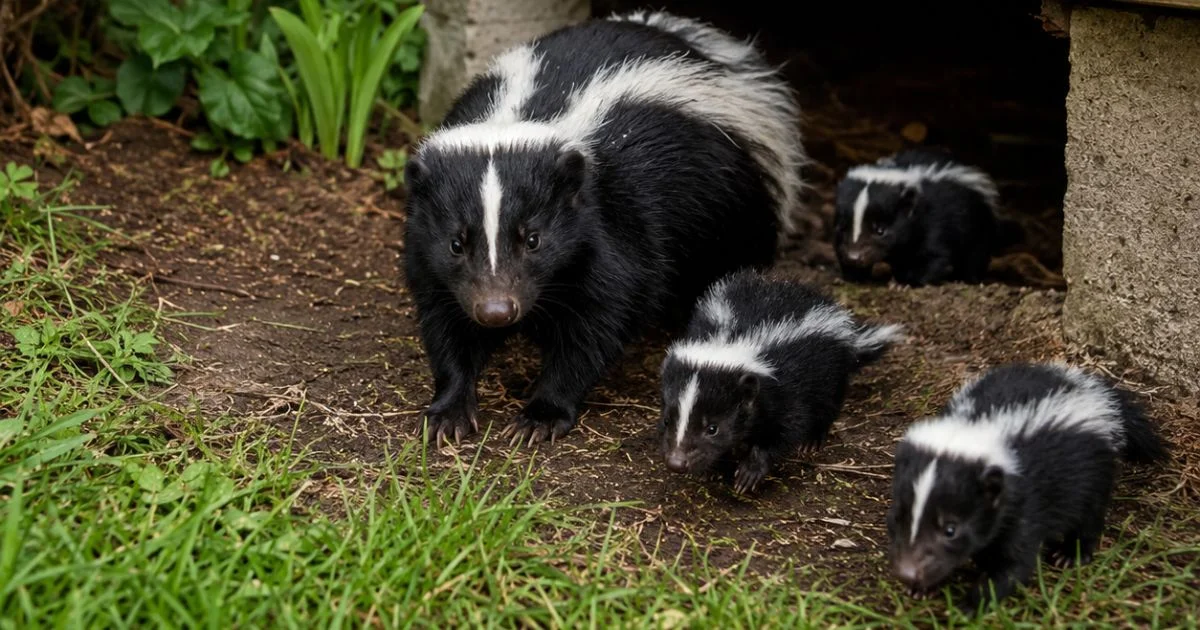
Baby skunks show up in Etobicoke yards every spring, and most homeowners have no idea what they are looking at. A kit near the porch looks abandoned, sick, or dangerous, so people either leave it alone too long or try to handle it themselves. Both choices cause problems. This guide walks Etobicoke residents through the full kit lifecycle, from birth in the den to spray development to the exact signs that mean a kit truly needs help, so they can tell the difference between a normal spring sighting and a real emergency before making a mistake that harms the animal or breaks Ontario wildlife law.
What Is a Baby Skunk Called?
A baby skunk is called a skunk kit. The common name kit covers every skunk offspring in a litter. Some people say skunk kitten, juvenile skunk, or skunk young. The baby skunk name stays the same across Ontario wildlife species.
In Etobicoke yards, the striped skunk is the kit you will find. Its scientific name is Mephitis mephitis. Molecular analysis in the 1990s triggered the mustelid reclassification. Skunk taxonomy Canada now places these animals inside Mephitidae. The family Mephitidae holds four species Mephitidae groups. Those groups are the hog nosed skunk, spotted skunk, hooded skunk and stink badger.
What Does a Baby Skunk Look Like at Birth?
Fur, Markings and Stripe Pattern in Newborn Kits
A skunk kit is born with markings already set. The white stripe pattern at birth sits over a black fur base. Melanin distribution controls this stripe pigmentation before birth. Newborn fur texture week one stays as fine sparse fur. Fur density is low, so stripe clarity stays weak. The dorsal white stripe is often fur too sparse to show clearly. Visible markings newborn improve fast. Black and white coloration becomes clear by full coat by week two.
Eyes, Ears and Teeth in the First Three Weeks
Kits stay eyes closed at birth. Ears sealed at birth match this same stage. Both senses reach the day 21 milestone together. Eyes open 21 days and ears open 21 days too. This concurrent eye and ear opening marks a key developmental milestone of 3 weeks. Around this point, first teeth emerge. Tooth emergence week three follows the wider dentition timeline. Experts call this stage neonatal sensory closure ending. It fits the pattern of altricial sensory development and sensory maturation in young mammals.
How a Kit’s Appearance Changes from Week One to Week Eight
Appearance week one shows a thin, sparse coat. Appearance week two brings the full fur coat week two. Appearance week three adds open eyes, matching eyes open week three. This is one clear stage in the physical growth timeline. Fur development stages continue through appearance week six. By then, body length 8 to 9 inches at six weeks is typical. Weight 1.5 pounds at six weeks is also common. Kit size progression continues toward appearance week eight. That stage reaches den ready size, the size at den exit for Etobicoke dens. This full week by week development pattern helps Etobicoke residents recognize a kit’s age on sight.
How Baby Skunks Develop Inside the Den
Week One and Two: Blind, Deaf and Dependent
A newborn kit fits the pattern of neonatal helplessness. It stays a blind mammal newborn and a deaf mammal newborn. Eyes closed weeks one and two and ears closed weeks one and two mark this stage. No teeth present means no solid food capacity yet. Exclusive milk feeding weeks one and two covers all nutrition. Total maternal dependence runs through this period. A kit is unable to thermoregulate on its own. The mother provides warmth at all times. There is no mobility weeks one and two. The spray gland is not yet functional at this stage.
Week Three: Eyes and Ears Open, Teeth Emerge
Week three brings a sensory activation milestone for the kit. Day 21 eye opening and day 21 ear opening happen together. First teeth visible week three marks early dental development. This stage brings the beginning of awareness for each kit. Response to stimuli week three grows stronger each day. Increased mobility week three lets kits shift inside the den. Early vocalization starts around this same point. Start of food awareness builds as environmental awareness begins.
Week Six to Eight: Full Fur, First Steps Outside the Den
Den exit age 6 to 8 weeks marks a major shift. Weight 1.5 pounds at exit and body length 8 to 9 inches at exit are typical. Full fur coat confirmed supports first outdoor exposure. Mother led foraging trips begin, often as short range exploration. Kits show return to the den after foraging each time. This matches spring emergence timing, usually late April to May emergence. Etobicoke yard’s first appearance often lines up with this window. Kit mobility at 6 weeks supports sibling exploration and growing kit independence begins.
What Do Baby Skunks Eat?
A baby skunk starts on an exclusive milk diet. Mother’s milk feeds the kit through mammary gland feeding. This nursing period runs about 6 to 8 weeks nursing. After the weaning timeline, solid food introduction begins the omnivore diet transition.
As an omnivore and part time insectivore, a young skunk eats earthworms, grubs, and beetles. Crane fly larvae and other soft insect prey round out its diet. It also eats berries, fruits, and general vegetation. Carrion, garbage, eggs and small rodents appear when available. A grub rich lawn is a common Etobicoke food source spot. Local garden Pestiseed prey benefits from strong suburban food availability.
Baby Skunk Behavior from Den to Independence
How Kits Follow Their Mother During Foraging
Kits use a single file formation when mother leads foraging. This is why kits follow in line behind her. Nocturnal foraging timing shapes this nighttime activity pattern. The trips build learned foraging behavior through observational learning. Young skunks gain food source identification skills through maternal teaching. Kit proximity to mother stays close during each trip. In Etobicoke, this happens along the Humber River Trail corridor and other Etobicoke park margins. Garden edge foraging is common near homes. Foraging range from den grows with kit stamina at 6 to 8 weeks.
When Baby Skunks Leave the Den for Good
Full 10 to 12 months of independence marks final separation from the family. This starts with late summer dispersal, known locally as fall dispersal Etobicoke. Home range establishment follows dispersal from natal den. Each kit begins separation from mother as part of sibling group dispersal. A young skunk starts a new den search soon after. This often means residential area entry at dispersal, seen as Etobicoke neighbourhood entry late summer. Independent foraging builds skills tied to juvenile territory. Sexual maturity 9 to 12 months follows close behind.
How Baby Skunks Behave Around Predators
A threatened kit follows a threat response escalation. It starts with foot stamping, then fur fluffing. Tail raising and a handstand position often come next. Spray as last resort is the final stage of predator deterrence. This warning display sequence works against a great horned owl predator, red fox predator, and coyote predator. A domestic dog threat or hawk predator can trigger the same response. Young skunks build spray accuracy development and predator avoidance learning over time.
Can Baby Skunks Spray? The Spray Gland Development Timeline
When the Spray Gland Becomes Functional
A spray gland present at birth does not work right away. This reflects an incomplete spray mechanism newborn stage with no accurate aim early stage. Kit spray capacity week one stays weak and unreliable. Kit spray capacity week three improves slightly with age. Scent gland development stages continue through spray gland maturation 3 months. Full functional capacity 3 months brings the first real spray accuracy milestone. This is the functional defensive spray age, matching kit spray capacity month three.
How Far and How Often a Kit Can Spray
Adult skunks reach an adult spray range 15 feet, or adult spray range 4.5 metres. Kit spray range shorter stays well under that distance. Each skunk holds a 5 to 6 sprays total capacity in its spray gland reservoir. This limited spray supply follows a 10 day regeneration period. The spray recharge biology sets a firm spray supply limit. Spray volume per discharge stays small in young kits. This builds a natural spray conservation instinct and spray as last resort behavior.
Warning Signs a Baby Skunk Gives Before Spraying
Every kit follows an escalating warning sequence before spraying. This starts with a foot stamping warning, then a fur fluffing display. Tail raising signals and hissing warnings often follow next. A handstand position marks the final warning before spray. Together, this forms the stomp fluff raise sequence and full defensive posture sequence. These are the clearest baby skunk spray warning signs in Etobicoke yards. Once an approach threshold is crossed, spray trigger behavior follows fast. The time to retreat after warning is short, so back away at the first warning behavior before spray.
Baby Skunks in Etobicoke: When and Where Kits Appear
Skunk Denning Near Residential Properties
Skunks den along the Humber River corridor near the Humber River Recreational Trail. Lambton Woods and Humber Valley offer strong wildlife corridor connectivity. This riparian corridor creates a green space for residential transition zones. Corridor edge habitat supports steady skunk movement along rivers. Many kits end up in a residential yard adjacent to the trail. Common sites include under deck denning, under porch denning, and shed base denning. Culvert denning, hollow log denning, and abandoned burrow denning also occur. These form the main urban denning sites across the area.
Etobicoke Neighbourhoods See Kits Earliest in Spring
Lake effect warming Mimico and lake effect warming Long Branch raise ground heat early. This comes from the Lake Ontario shoreline effect on nearby soil. Higher April soil temperature and April air temperature trigger emergence. Inland Etobicoke emergence May follows a few weeks later. Marie Curtis Park, Centennial Park and James Gardens show this pattern each year, matching wider seasonal phenology Etobicoke trends.
Older Homes in Mimico and Long Branch Are Common Den Sites
Many have low deck clearance, often deck clearance 8 to 12 inches. A cracked concrete porch skirt becomes a common skunk access point. Any gap under the deck creates structural den access for kits. This pattern repeats across older New Toronto housing stock. Older bungalow den risk often starts with a small foundation gap. Shed base access adds another entry option. Together, these residential den site conditions and porch structure skunk entry points explain why kits favor these blocks.
Found Signs of a Skunk Den Under Your Deck or Porch?
If skunks are using gaps beneath your deck, porch, or shed, Pestiseed can help assess the activity and discuss appropriate removal options. Avoid handling baby skunks yourself, especially if you are unsure whether the mother is nearby.
I Found a Baby Skunk in Etobicoke: What Should I Do?
How to Tell If a Kit Is Orphaned or Simply Alone Temporarily
Nocturnal maternal foraging explains most cases of mother foraging absence. A kit left in the den while mother forages shows temporary separation normal for the species. An alert and reactive kit is a strong sign among healthy kit indicators. Observe before intervening rather than acting right away. Skunk tracking by scent allows scent tracking mother and kit to reunite naturally. This supports kit reunification with mother within hours. Watch for an hour absence indicator, since this marks the real lone kit concern threshold separating lone kit normal behavior from true orphaned kit signs.
Signs a Baby Skunk Needs Immediate Help
Fly eggs on kit, often with a fly eggs rice grain appearance, signal trouble fast. Obvious injury signs or confirmed dog or cat contact are urgent. A cold and unresponsive kit or slow moving kit needs help now. A wet kit left alone adds further risk. Eyes still closed and alone is a serious all day alone indicator. Confirmed cases include mother confirmed deceased or mother illegally relocated. Watch for dehydration signs and starvation signs as part of a full distress indicators checklist. Any of these count as immediate intervention triggers.
FAQs
Do baby skunks carry rabies?
Yes. Skunks are a skunk primary rabies vector and rabies vector species Ontario. Rabies transmission risk exists in skunk rabies even in young kits. Toronto Public Health rabies and Health Canada rabies guidance confirm do not handle rabies risk.
How long does a baby skunk stay with its mother?
A kit stays with its mother for 10 to 12 months total maternal period. This covers the summer family group and continues as kit follows mother summer months, ending near fall separation or end of summer dispersal.
What time of year do baby skunks appear in Etobicoke?
Most kits follow Ontario skunk birth May to June. Etobicoke emergence late April southern zones starts first, followed by Etobicoke emergence May inland zones.
Can I raise a baby skunk I found in Ontario?
No. The Ontario Fish and Wildlife Conservation Act makes raising wild skunks illegal in Ontario without an MNRF wildlife permit. Contact a licensed wildlife rehabilitator in Ontario instead of attempting captive wildlife prohibition violations.
Noticing Skunks or a Possible Den on Your Property?Let Pestiseed Help You Find the Next Step
Whether you have spotted baby skunks near your home or suspect a den beneath a deck or porch, Pestiseed can help assess skunk activity and discuss suitable removal options. Contact our team for skunk removal in Etobicoke, Toronto, and the surrounding GTA.