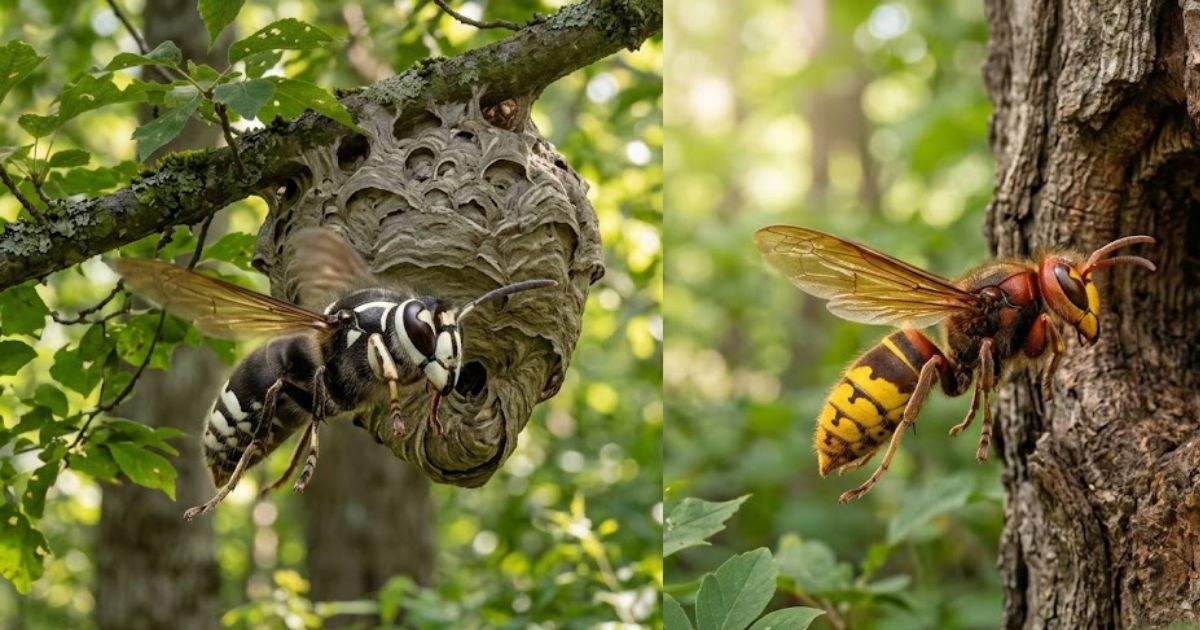
Hornets are large social wasps with thick bodies, strong mandibles and enclosed nests. Ontario is home to only two true hornets. The bald faced hornet (Dolichovespula maculata) grows naturally across Canada as a native species. Vespa cabrio, the European hornet, arrived here as an introduced species from Europe. Both belong to the Vespidae family of social wasps.
We regularly spot the bald faced hornet across Ontario’s forests near Toronto. European hornets mostly stay in southern regions of Ontario. Natural Resources Canada tracks their geographic range across Canada. The Canadian Wildlife Federation also notes both species spreading through Ontario.
How Do You Identify Hornets in Ontario?
Key Physical Characteristics
Hornet identification starts with size, face pattern, color contrast, then nest. A thicker thorax and wider head capsule make hornets look bigger than do wasps die after stinging. Compound eyes, strong mandibles and a smooth stinger confirm hornet morphology. Scan abdomen segments, wing span, wings and antennae to finish your ID.
Quick Visual Identification Checklist
| Feature | Bald Faced Hornet | European Hornet |
| Color | Black & white | Brown & yellow |
| Size | 12–18 mm workers | 18–35 mm |
| Face pattern | White mask | Orange/yellow face |
| Nest type | Paper aerial nest | Hollow tree cavities |
What Hornet Species Live in Ontario?
Bald Faced Hornet (Dolichovespula maculata)
Dolichovespula maculata thrives in Ontario’s forest habitat and urban environment. Surprisingly this species is technically a yellow jacket, not a true hornet. A colony size holds up to 400 worker caste members. That black body and white facial markings make this hornet easy to spot.
European Hornet (Vespa crabro)
Vespa crabro builds wood cavity nests across Ontario’s local ecosystem. This nocturnal wasp hunts insects and forages actively after dark. Lights attract them, often causing misidentification as invasive giant hornets. Spot it by large body size, reddish brown thorax and yellow abdomen stripes.
Bald Faced Hornet vs European Hornet
| Attribute | Bald Faced Hornet | European Hornet |
| Scientific name | Dolichovespula maculata | Vespa crabro |
| Nest location | Trees, shrubs, buildings | Hollow trees, walls |
| Nest shape | Large gray paper sphere | Hidden cavity nests |
| Worker size | 12–15 mm | 18–25 mm |
| Queen size | 18–20 mm | 30–35 mm |
| Activity pattern | Daytime | Often nocturnal |
What Do Hornet Nests Look Like?
Bald Faced Hornet Nests
Workers chew wood fibers and mix them with saliva to form paper pulp. That pulp dries into layered walls around the colony structure. You’ll find these grey, football shaped hornet nests hanging from trees or eaves. We’ve spotted them tucked in Toronto backyards more than anywhere else.
European Hornet Nests
European hornet nests grow inside wall voids, attics or hollow logs. They use the same paper pulp process but build inside dark, hidden cavities. The colony structure stays protected and out of plain sight. Spotting these early saves you a nasty surprise later.
How to Tell Hornets Apart from Similar Wasps
Hornets vs Yellowjackets
About 70% of reported hornets in Toronto are actually yellow jackets. Both share a similar body shape and yellow black coloring. Hornets build enclosed aerial nests while yellow jackets nest underground. Social structure also differs since hornet colonies grow much larger.
Hornets vs Paper Wasps
Paper wasps build open, umbrella shaped combs without any covering. Wasp identification gets easier once you check that nest shape first. Hornets always enclose their nests in full layered walls. Paper wasps also carry longer dangling legs during flight.
Hornets vs Cicada Killer Wasps
Cicada killers live and hunt completely alone, unlike hornets. Their nesting behavior involves digging solo burrows into soft soil. Size makes them easy to confuse with true hornets at first. Spotting one near garden soil in Toronto rules out a hornet fast.
Seasonal Hornet Activity in Ontario
Ontario’s cold winters wipe out entire hornet colonies every year. Only a mated queen emergence survives by hiding under bark or soil. She alone restarts the hornet lifecycle each spring from scratch. That’s something most Toronto homeowners never realize until nests show up again.
By summer, colony growth explodes fast as the worker population builds out the nest. Late August brings peak aggression since workers defend a now large colony hard. First frost shuts everything down and kills all workers off completely. Queens then find shelter and quietly wait out another Toronto winter.
Are Hornets Dangerous to Humans?
Sting Characteristics
A hornet sting delivers venom packed with acetylcholine, histamine and kinins. These compounds hit nerves, skin and blood vessels all at once. That’s why the burn from a hornet feels sharper than a regular bee sting. People with allergic reactions face the biggest risk from even one sting.
Aggression Triggers
Defensive behavior kicks in fast when a nest feels threatened nearby. Vibrations, sudden movement or loud noise near a nest set them off. We’ve seen Toronto homeowners accidentally trigger swarms just mowing too close. Stay calm, move slowly and never swat at them near a nest.
Where Hornets Commonly Build Nests Around Homes
Residential hornet nests show up on roof eaves, tree branches and sheds across Toronto. Hornets now adapt well to city living, nesting in soffits and attic vents too. We find hidden nests inside wall cavities more often than most people expect. Urban homes give them shelter, warmth and easy access all season long.
Check corners of your porch, garage edges and fence posts regularly. Decks, outdoor furniture frames and low tree limbs attract them fast. Spotting a nest early makes removal far safer and much simpler. A nest found in July is always easier to handle than one found in August.
Signs a Hornet Nest Is Nearby
A steady buzzing noise near your roofline is a clear warning sign. Watch for repeated hornet activity signs around the same spot each day. Professionals track flight paths to trace workers straight back to the nest. We use this same return route method on every Toronto property we inspect.
Nest sightings confirm the problem but flight patterns reveal it much earlier. You’ll notice hornets flying in and out of one fixed point. That repeated line of movement points directly to a hidden nest. Catching this pattern early gives you a much safer removal window.
Seeing Hornets Returning to the Same Spot?
Repeated hornet activity around an eave, wall, tree, or roofline may point to a nearby nest. Pestiseed can inspect the activity, identify the nest location, and recommend the right removal approach.
Licensed & Insured
Toronto & GTA
Professional Pest Control
What to Do If You Find a Hornet Nest
Start with a quick risk assessment based on nest size and human proximity. A large nest near a doorway needs professional hornet nest management right away. Keep safe distance safely by staying at least 20 feet back always. Good news though hornets never reuse the same nest next spring.
That winter die off fact changes how you handle a late season find. A nest in October poses far less risk than one found in July. Human proximity to high traffic areas still decides how fast you act. Call a pro when the nest sits close to kids, pets, or entryways.
How Pest Control Professionals Remove Hornet Nests
Pestiseed Pest Control Etobicoke always schedules hornet extermination after sunset for one key reason. Nearly all workers return to the nest once the sun goes down. Treating at night means more hornets contacted and a much higher success rate. Our technicians suit up in full protective equipment before getting anywhere close.
Insecticidal dust gets injected directly into the nest entry point first. Dust travels deep inside and reaches hornets that sprays simply cannot hit. Pest control professionals then seal the opening to trap any remaining insects inside. This two step method beats a daytime spray attempt every single time.
FAQs
How big are hornets in Ontario?
Bald faced hornets grow up to 19mm long in Ontario. European hornets reach up to 35mm, making them the largest species here. Size alone helps separate true hornets from smaller wasps quickly.
Do hornets return to the same nest?
No, hornets never reuse old nests. Ontario’s cold winters kill off entire colonies every year. Only the queen survives and builds a completely fresh nest each spring.
Are bald faced hornets actually hornets?
Technically, no. Bald faced hornets belong to the Dolichovespula genus, which makes them yellowjackets. True hornets belong to the Vespa genus, like the European hornet found in Ontario.
What attracts hornets to homes?
Hornets seek sheltered spots with easy food access nearby. Roof eaves, wall cavities, and attic vents give them perfect nesting conditions. Sweet smells, exposed wood and insects around your yard also pull them in.
Are hornets beneficial to ecosystems?
Yes, hornets actually help control insect populations naturally. They hunt flies, caterpillars and garden pests to feed their colonies. We always assesses nest location before recommending removal to protect local hornet ecology.
Hornet Nest Removal Services in Ontario Get Expert Help Today
Pestiseed Pest Control Etobicoke removes both aerial hornet nest types and hidden cavity nests. Most pest control companies treat all nests the same way we never do. Wasp nest removal need a completely different approach than buried European hornet cavities. Our pest control experts in Ontario identify the species first, then remove it safely. That species specific process protects your family and gets the job done right. A wrong treatment method on the wrong nest type always makes things worse.
Found a Hornet Nest Around Your Property?
Let Pestiseed Identify and Handle It.
Whether the nest is hanging from a tree or hidden inside a wall, soffit, or attic, Pestiseed can assess the activity and recommend the appropriate hornet control approach across Toronto and the GTA.
Licensed & Insured
Toronto & GTA
Pest & Wildlife Control